The Sacred and The Profane: The Nature of Religion
Product ID: 3500332
Buy anything from 5,000+ international stores. One checkout price. No surprise fees. Join 2M+ shoppers on Desertcart.
Desertcart purchases this item on your behalf and handles shipping, customs, and support to Botswana.
A groundbreaking work on myth, symbol, and ritual by one of the most acclaimed historians of our time. In The Sacred and the Profane, Mircea Eliade observes that while contemporary people believe their world is entirely profane or secular, they still at times find themselves connected unconsciously to the memory of something sacred. It's this premise that both drives Eliade's exhaustive exploration of the sacred—as it has manifested in space, time, nature and the cosmos, and life itself—and buttresses his expansive view of the human experience. Review: Must Read : Review from Re-Reading the Classic - Nature of Religion In his introductory work into the subject of the fundamental quintessence of religion, Mircea Eliade introduces the basic approach and theme of any religious experience as a hierophany, the "act of manifestation" of the Sacred that brakes into the homogeneous nature of the Profane (11). Despite the vastness of the modes of manifestations of such hierophanies, they all share a basic congruence, which can be identified, studied, and demonstrated in a "primitive" religious expression throughout the world. Similarly, there is a paradigm of similarities of the various internalizations and responses that individuals and societies incorporated into the nature of their being in response to this sacred manifestation. Moreover, Eliade points out that the manifestations of this response can be found not only in "primitive" religions, but also in more complicated and sophisticated religion; furthermore, they are present in the declaratory desacralized expressions of modernity. Properly, all the variations of this response to a hierophanies can be found in the heart of the definition of human religious experience and constitute the core of religion. Homo Religious in Traditional Society Whether they occur in the remote past or happen in contemporary societies where the Profane has not established its firm ground, there are number of almost universally similar responses to a hierophany, which constitute the basic fabric of religion. Namely, when the sacred is manifested, a homo religious attempts to cling, to become one with the sacred. Using multiple examples from various and diverse cultures of traditional societies, Eliade both demonstrates and builds his theory on this principle. Namely, whether hierophany is represented by a polar, totem, mounting, stone, an opening in the roof, it always occupies the central place for the homo religious. It is the center of his universe, from which he settles by repeating cosmological mythical prehistory (47).This centrality, which Eliade refers by the term of " axis mundi" is paramount for the individual in traditional society (43). Besides various manifestations of the axis mundi, such individual and his or her society incorporates the sacred into the fabric of their being by other channels. Here lays the understanding of human body, devouring food as a sacramental meal, and various rituals with a rich mythology. Eliade accentuates the importance of the last by describing how the rituals were created to demonstrate the sacred cosmological processes. By participating in cyclical rituals of the year or rites of passage, the individual and his society repeats and recreates in miniature the cosmological drama of the prehistoric, originating stories of chaos and order to the point not merely the "commemoration of a mythical...even", but create something that "reactualizes the event" of creation (81,99).These rituals also transmitted idea that the death is only the beginning of another cycle of rebirth. Individual in traditional society also draws the rich imaginary of symbolic correlation between his immediate life and that of water, son, and moon. Ultimately, Eliade points that ability to connect to the sacred by the described above means constitutes the state in which a "primitive" individual obtains true being, the real life. This connection makes the possibility of the sanctification of the human life conceivable in the universe that is always wholly alive (165,167). Such sanctification incorporates the entire universe in which this individual resides. Physiological acts of consuming food, sex, as well as birth, puberty, death, human dwellings - this all becomes not only the projection of the sacred, but the Sacred in its proper sense. This mode of existence begins with the first breath of the human being and follows him throughout his or her life without leaving any gaps for the occurrence of the truly profane actuality. Judeo-Christian Heritage in the Mosaic of History of Religion Mainly, Eliade points to the differences in the concept of the sacred time that sets religions of the Judeo-Christian heritage on different footing. For the "primitive" religions, the sacred time is completely reversible and cyclical (68, 69, 73, and 75). It has been renewed within the yearly cycles or cosmic yugas in Hinduism (75,107,108). Even more, during various festivals, the individual becomes "contemporary with the cosmogony", "present at the creation of the world" (79, 87, 91). Such individual gains a new beginning by participating in such rites and symbolically descending into the primordial chaos and rising to the new life (94,105, 106). Hence, here he or she seeks the cure from all the calamities of an individual and society (82, 83). Nevertheless, this unbroken cycle is not fund in the Abrahamic religions. Here, God's theophany comes not in the "cosmic time", but in particular "historical time" that has the beginning and the projected end (110). The cosmos is no longer constitutes the repeatable drama of recreation. Although hierophany still occurs, it's primarily reduced to the theophany. Christianity, in which the Ultimate Reality becomes incarnate, creates possibility, promise, and hope of sanctification of the history itself (111). Although both Judaism and Christianity rely on and use the liturgical calendar, its various points celebrate numerous events of the past and do not attempt to recreate them in the same fashion as the "primitive" religions of traditional societies. Moreover, these celebrations commemorate the events that occurred in the historical time, not "at the origin of time" (111). Hence, the cyclical nature of time is abolished to give way for the linear interpretation of time. In addition, Eliade also points to what he presumes to be the different modes of Christianity in the Europe of his age. Namely, the author distinguishes "rural populations" and urban Christianity (178). If the former still retained some distinctions of the "cosmic liturgy", the latter "is no longer open to the cosmos" (178, 179). One should add that despite the activities of various movements in the recent past, since the time when the first edition of The Sacred And The Profane has been published, the European balance in the described by Eliade dichotomy shifted even more toward the point of full elimination of the remains of the practitioners of the "cosmic liturgy" on that continent. Religion and Modernity Eliade describes the mental universe of the "modern" humanity as chiefly characterized by its desacralization. This desacrialization touched all spheres of the inner and outward life of the individual, stripped himself or herself from the Sacred; in addition, the degree by which he or she becomes free directly corresponds to the extent by which a "modern" individual is "demysticizied" (203). Eliade pursues in a great length the portrayal of the microcosm of such individual in contrast to that of homo religious. Namely, he points that the multidimensional life of the latter is not available to the representative of the "modern" humanity. Physiological acts that are part of the sacred word for the homo religious have lost its otherness, sacredness, the richness of being the communiqué with the transcended (168). Consequently, acts of eating, having sexual relations, procreating, or even urinating are without any sacred significance. Eliade also depicts the same process and the point of arrival to the present desacralization in the dimension of "Body-House-Cosmos" (172-179). The same also applies to the rites of passage, characterized by the "radical secularization of death, marriage, and birth" (186). This secularization leaves the "modern" individual alone at the end of his journey, without described by Eliade defense mechanisms, developed by the homo religious to find peace and hope of the new birth in the cyclical modus operandi of the universe (196,201). Hence, the "modern" humanity faces existential crisis. With the exception of brief mentioning of Hegel's geist, Eliade does not describe or evaluate the answers to this challenge that the modern philosophical thought proposed in order to resolve this crisis (112). Nevertheless, Eliade pursues another path; he demonstrates that in a paradoxical way, the "modern" humanity still retains much of the traits and somewhat hidden characteristics of the representatives of the traditional society. New Hope Despite the fact that Eliade depicts a deem portrait of the "modern" individual, who no longer resides in a "open cosmos", his views on the future of religious dimension of humanity are undoubtedly optimistic. The source of this optimism lays in the fact that "a purely rational man is an abstraction; he is never found in real life" (209). The author demonstrates that despite the outward brake with the past, society and a person that had been declaratory stripped from religion in fact retains most of its characteristics, whether consciously or subconsciously. Sometimes these characteristics are hidden, sometimes they are openly observable. Namely, Eliade points to what he calls "little religions", the Marxism, "modern "private mythologies"", "initiatory scenarios", "the cinema" and even "reading" (205, 206, 207,208, 211).Eliade also points that the "modern" humanity can not separate itself from the traditional one due to the fact that in its nature the former is the mere "product" of the latter (204). Although author does not state it explicitly, he implies that the "modern" individual in his or her core is still deeply homo religious. Personally, I think that one of the great passages of this book is found at the conclusion of the Chapter IV. I agree with Eliade's brilliant characterization of the condition of the "modern" individual as the "second fall" (213). Religion in general and Christianity in particular are charged with the "awakening" of the "modern" humanity from its lethargic nightmare. Just as the early Church Fathers via the practice of "stealing from Egyptians" incorporated the best of the "pagan" achievements into Christian theology, the Church of today, una sancta, shall use the accomplishments of the modernity while providing a channel of connection with the divine and the sacred. In this task, the incredible mosaic of Christian diversity serves as a helpful tool to reach the diverse inquiries that are able to fulfill the gap in the psyche of the modernity. Where sacraments can be used by one branch of the Christianity in order to allow the "modern" individual touch the divine, they shall be used; where undivided fusion of rationalization with the understanding that humanity is an integral part of the universe and thus have to behave in a responsible manner is stressed, this approach shall be practiced as well. In this tremendous task, the Church shall also learn from the various successful and failed responses to modernity, offered by the other religions in Abrahamic tradition and beyond. Nevertheless, whichever steps are taken or paths are chosen, we should be in debt to Eliade for his description of the nature of the current separation of the humanity from the cosmos and the Sacred. Old and New This is not the first time I have been turning the pages of this book; however, it is the first time that I read it in an English translation. Soon after the fall of the Soviet Union, Eliade's works became available in Russian translation. Hence, I read this book during my study at the newly established at that time Rivne Theological Seminary in Ukraine around 1996-1997. Understandably, Mircea Eliade remains to be a controversial figure in my old homeland due to the well-known allegations of his connections to the Iron Guard, work in Antonescu's diplomatic services, and particularly reported stance on Jewish minorities in Bukovina and Bessarabia, the territories which now belong to Ukraine. However, no one denies his genius when it comes to the history and philosophy of religions. I can still recall the deep impact that the book had on me, challenging and forcing to re-evaluate basic presuppositions of my worldview. I remember struggling with the idea of basic congruence of the fundamental rites of different religions, carried from the traditional society to modernity. Although the reconciliation of this crisis came much later in my life, the experience of reading and contemplating on Eliade's works made a significant impact of my outlook and formation of the theological worldview. In addition, Eliade's treatment of Marxist ideology was more than very acute and recalled the fresh memories of the resent past at that time (206-207). Although Eliade does not go into many details, but every citizen of the former USSR can recognize through his work multiple signs of both modern and traditional society, which Marxism had introduced or transformed into new forms for our society. At this time, reading the book in different translation and in a considerable distance from first encounter, I've found many points that were missed or for which I was not ready at that time. I was also catching myself on the length of the theological and ideological distance that I've traveled since. Without questions, Eliade was one of the catalysts of this change and growths. But the best comes from understanding that this journey to the comprehension of the Sacred and the Profane for me has only truly begun. Review: What are we searching for? - This is a keystone book in understanding how cultures assemble structures of meaning. I think most of us have experienced a higher state of awareness, a feeling where our outer bounds dissolve and we become more than could ever be alone. This book is a synthesis of all the similarities that draw together humanity's sacred impulse -- what are the commonalities across the world of cultures as we reach for something higher? Even if we're just fulfilling a psychological need, understanding the pattern of that need's fulfillment tells us something essential about who we are. I think this is a book that tells us what we're searching for. It looks at the broad span of culture and says, "This is what we've done over the entire course of our existence to fill our void." I think about this book all the time. I see it everywhere I go. When I see everyone creating a common belief in the culture that everyone rallies around so that it becomes equivalent to the fabric of reality itself, I go, "This is totally an axis mundi right now." When I feel light as a feather, like I've stepped out of the dreariness of my day-to-day, I wonder what I did to step out of profane time and into sacred space. I wonder how cultures figured that out and embedded it into their yearly practice. The most interesting thing about this book is how tribes found ways to recapitulate their foundational stories: their myths, their cosmogonies, their grand narrative and moral order. I think this is a key to understanding the origin of human culture, and how we've survived to this day. We embed rituals into the cultural fabric to synchronize our perceptions, to keep all of us processing the meaning of the world in the same terms. It's what defines a people, it's what allows for us to keep in solidarity even though we're not related by blood. When you hear the ancient songs of a people long dead, and it speaks to something deep and forgotten in you, you will know what this book is trying to say. This is my favorite non fiction book of all time (so far), and the one I can't stop gushing about to everyone.
| Best Sellers Rank | #23,180 in Books ( See Top 100 in Books ) #18 in Religion & Philosophy (Books) #18 in Comparative Religion (Books) #48 in Religious Philosophy (Books) |
| Customer Reviews | 4.6 out of 5 stars 537 Reviews |
S**K
Must Read : Review from Re-Reading the Classic
Nature of Religion In his introductory work into the subject of the fundamental quintessence of religion, Mircea Eliade introduces the basic approach and theme of any religious experience as a hierophany, the "act of manifestation" of the Sacred that brakes into the homogeneous nature of the Profane (11). Despite the vastness of the modes of manifestations of such hierophanies, they all share a basic congruence, which can be identified, studied, and demonstrated in a "primitive" religious expression throughout the world. Similarly, there is a paradigm of similarities of the various internalizations and responses that individuals and societies incorporated into the nature of their being in response to this sacred manifestation. Moreover, Eliade points out that the manifestations of this response can be found not only in "primitive" religions, but also in more complicated and sophisticated religion; furthermore, they are present in the declaratory desacralized expressions of modernity. Properly, all the variations of this response to a hierophanies can be found in the heart of the definition of human religious experience and constitute the core of religion. Homo Religious in Traditional Society Whether they occur in the remote past or happen in contemporary societies where the Profane has not established its firm ground, there are number of almost universally similar responses to a hierophany, which constitute the basic fabric of religion. Namely, when the sacred is manifested, a homo religious attempts to cling, to become one with the sacred. Using multiple examples from various and diverse cultures of traditional societies, Eliade both demonstrates and builds his theory on this principle. Namely, whether hierophany is represented by a polar, totem, mounting, stone, an opening in the roof, it always occupies the central place for the homo religious. It is the center of his universe, from which he settles by repeating cosmological mythical prehistory (47).This centrality, which Eliade refers by the term of " axis mundi" is paramount for the individual in traditional society (43). Besides various manifestations of the axis mundi, such individual and his or her society incorporates the sacred into the fabric of their being by other channels. Here lays the understanding of human body, devouring food as a sacramental meal, and various rituals with a rich mythology. Eliade accentuates the importance of the last by describing how the rituals were created to demonstrate the sacred cosmological processes. By participating in cyclical rituals of the year or rites of passage, the individual and his society repeats and recreates in miniature the cosmological drama of the prehistoric, originating stories of chaos and order to the point not merely the "commemoration of a mythical...even", but create something that "reactualizes the event" of creation (81,99).These rituals also transmitted idea that the death is only the beginning of another cycle of rebirth. Individual in traditional society also draws the rich imaginary of symbolic correlation between his immediate life and that of water, son, and moon. Ultimately, Eliade points that ability to connect to the sacred by the described above means constitutes the state in which a "primitive" individual obtains true being, the real life. This connection makes the possibility of the sanctification of the human life conceivable in the universe that is always wholly alive (165,167). Such sanctification incorporates the entire universe in which this individual resides. Physiological acts of consuming food, sex, as well as birth, puberty, death, human dwellings - this all becomes not only the projection of the sacred, but the Sacred in its proper sense. This mode of existence begins with the first breath of the human being and follows him throughout his or her life without leaving any gaps for the occurrence of the truly profane actuality. Judeo-Christian Heritage in the Mosaic of History of Religion Mainly, Eliade points to the differences in the concept of the sacred time that sets religions of the Judeo-Christian heritage on different footing. For the "primitive" religions, the sacred time is completely reversible and cyclical (68, 69, 73, and 75). It has been renewed within the yearly cycles or cosmic yugas in Hinduism (75,107,108). Even more, during various festivals, the individual becomes "contemporary with the cosmogony", "present at the creation of the world" (79, 87, 91). Such individual gains a new beginning by participating in such rites and symbolically descending into the primordial chaos and rising to the new life (94,105, 106). Hence, here he or she seeks the cure from all the calamities of an individual and society (82, 83). Nevertheless, this unbroken cycle is not fund in the Abrahamic religions. Here, God's theophany comes not in the "cosmic time", but in particular "historical time" that has the beginning and the projected end (110). The cosmos is no longer constitutes the repeatable drama of recreation. Although hierophany still occurs, it's primarily reduced to the theophany. Christianity, in which the Ultimate Reality becomes incarnate, creates possibility, promise, and hope of sanctification of the history itself (111). Although both Judaism and Christianity rely on and use the liturgical calendar, its various points celebrate numerous events of the past and do not attempt to recreate them in the same fashion as the "primitive" religions of traditional societies. Moreover, these celebrations commemorate the events that occurred in the historical time, not "at the origin of time" (111). Hence, the cyclical nature of time is abolished to give way for the linear interpretation of time. In addition, Eliade also points to what he presumes to be the different modes of Christianity in the Europe of his age. Namely, the author distinguishes "rural populations" and urban Christianity (178). If the former still retained some distinctions of the "cosmic liturgy", the latter "is no longer open to the cosmos" (178, 179). One should add that despite the activities of various movements in the recent past, since the time when the first edition of The Sacred And The Profane has been published, the European balance in the described by Eliade dichotomy shifted even more toward the point of full elimination of the remains of the practitioners of the "cosmic liturgy" on that continent. Religion and Modernity Eliade describes the mental universe of the "modern" humanity as chiefly characterized by its desacralization. This desacrialization touched all spheres of the inner and outward life of the individual, stripped himself or herself from the Sacred; in addition, the degree by which he or she becomes free directly corresponds to the extent by which a "modern" individual is "demysticizied" (203). Eliade pursues in a great length the portrayal of the microcosm of such individual in contrast to that of homo religious. Namely, he points that the multidimensional life of the latter is not available to the representative of the "modern" humanity. Physiological acts that are part of the sacred word for the homo religious have lost its otherness, sacredness, the richness of being the communiqué with the transcended (168). Consequently, acts of eating, having sexual relations, procreating, or even urinating are without any sacred significance. Eliade also depicts the same process and the point of arrival to the present desacralization in the dimension of "Body-House-Cosmos" (172-179). The same also applies to the rites of passage, characterized by the "radical secularization of death, marriage, and birth" (186). This secularization leaves the "modern" individual alone at the end of his journey, without described by Eliade defense mechanisms, developed by the homo religious to find peace and hope of the new birth in the cyclical modus operandi of the universe (196,201). Hence, the "modern" humanity faces existential crisis. With the exception of brief mentioning of Hegel's geist, Eliade does not describe or evaluate the answers to this challenge that the modern philosophical thought proposed in order to resolve this crisis (112). Nevertheless, Eliade pursues another path; he demonstrates that in a paradoxical way, the "modern" humanity still retains much of the traits and somewhat hidden characteristics of the representatives of the traditional society. New Hope Despite the fact that Eliade depicts a deem portrait of the "modern" individual, who no longer resides in a "open cosmos", his views on the future of religious dimension of humanity are undoubtedly optimistic. The source of this optimism lays in the fact that "a purely rational man is an abstraction; he is never found in real life" (209). The author demonstrates that despite the outward brake with the past, society and a person that had been declaratory stripped from religion in fact retains most of its characteristics, whether consciously or subconsciously. Sometimes these characteristics are hidden, sometimes they are openly observable. Namely, Eliade points to what he calls "little religions", the Marxism, "modern "private mythologies"", "initiatory scenarios", "the cinema" and even "reading" (205, 206, 207,208, 211).Eliade also points that the "modern" humanity can not separate itself from the traditional one due to the fact that in its nature the former is the mere "product" of the latter (204). Although author does not state it explicitly, he implies that the "modern" individual in his or her core is still deeply homo religious. Personally, I think that one of the great passages of this book is found at the conclusion of the Chapter IV. I agree with Eliade's brilliant characterization of the condition of the "modern" individual as the "second fall" (213). Religion in general and Christianity in particular are charged with the "awakening" of the "modern" humanity from its lethargic nightmare. Just as the early Church Fathers via the practice of "stealing from Egyptians" incorporated the best of the "pagan" achievements into Christian theology, the Church of today, una sancta, shall use the accomplishments of the modernity while providing a channel of connection with the divine and the sacred. In this task, the incredible mosaic of Christian diversity serves as a helpful tool to reach the diverse inquiries that are able to fulfill the gap in the psyche of the modernity. Where sacraments can be used by one branch of the Christianity in order to allow the "modern" individual touch the divine, they shall be used; where undivided fusion of rationalization with the understanding that humanity is an integral part of the universe and thus have to behave in a responsible manner is stressed, this approach shall be practiced as well. In this tremendous task, the Church shall also learn from the various successful and failed responses to modernity, offered by the other religions in Abrahamic tradition and beyond. Nevertheless, whichever steps are taken or paths are chosen, we should be in debt to Eliade for his description of the nature of the current separation of the humanity from the cosmos and the Sacred. Old and New This is not the first time I have been turning the pages of this book; however, it is the first time that I read it in an English translation. Soon after the fall of the Soviet Union, Eliade's works became available in Russian translation. Hence, I read this book during my study at the newly established at that time Rivne Theological Seminary in Ukraine around 1996-1997. Understandably, Mircea Eliade remains to be a controversial figure in my old homeland due to the well-known allegations of his connections to the Iron Guard, work in Antonescu's diplomatic services, and particularly reported stance on Jewish minorities in Bukovina and Bessarabia, the territories which now belong to Ukraine. However, no one denies his genius when it comes to the history and philosophy of religions. I can still recall the deep impact that the book had on me, challenging and forcing to re-evaluate basic presuppositions of my worldview. I remember struggling with the idea of basic congruence of the fundamental rites of different religions, carried from the traditional society to modernity. Although the reconciliation of this crisis came much later in my life, the experience of reading and contemplating on Eliade's works made a significant impact of my outlook and formation of the theological worldview. In addition, Eliade's treatment of Marxist ideology was more than very acute and recalled the fresh memories of the resent past at that time (206-207). Although Eliade does not go into many details, but every citizen of the former USSR can recognize through his work multiple signs of both modern and traditional society, which Marxism had introduced or transformed into new forms for our society. At this time, reading the book in different translation and in a considerable distance from first encounter, I've found many points that were missed or for which I was not ready at that time. I was also catching myself on the length of the theological and ideological distance that I've traveled since. Without questions, Eliade was one of the catalysts of this change and growths. But the best comes from understanding that this journey to the comprehension of the Sacred and the Profane for me has only truly begun.
J**T
What are we searching for?
This is a keystone book in understanding how cultures assemble structures of meaning. I think most of us have experienced a higher state of awareness, a feeling where our outer bounds dissolve and we become more than could ever be alone. This book is a synthesis of all the similarities that draw together humanity's sacred impulse -- what are the commonalities across the world of cultures as we reach for something higher? Even if we're just fulfilling a psychological need, understanding the pattern of that need's fulfillment tells us something essential about who we are. I think this is a book that tells us what we're searching for. It looks at the broad span of culture and says, "This is what we've done over the entire course of our existence to fill our void." I think about this book all the time. I see it everywhere I go. When I see everyone creating a common belief in the culture that everyone rallies around so that it becomes equivalent to the fabric of reality itself, I go, "This is totally an axis mundi right now." When I feel light as a feather, like I've stepped out of the dreariness of my day-to-day, I wonder what I did to step out of profane time and into sacred space. I wonder how cultures figured that out and embedded it into their yearly practice. The most interesting thing about this book is how tribes found ways to recapitulate their foundational stories: their myths, their cosmogonies, their grand narrative and moral order. I think this is a key to understanding the origin of human culture, and how we've survived to this day. We embed rituals into the cultural fabric to synchronize our perceptions, to keep all of us processing the meaning of the world in the same terms. It's what defines a people, it's what allows for us to keep in solidarity even though we're not related by blood. When you hear the ancient songs of a people long dead, and it speaks to something deep and forgotten in you, you will know what this book is trying to say. This is my favorite non fiction book of all time (so far), and the one I can't stop gushing about to everyone.
C**S
A classic work in the field
First, I should stress that I do not entirely agree with all of Eliade's ideas. His ideas about the nature of religion strike me as interesting and probably correct in some of their outlines but also a bit dated and ethnocentric as well in some areas (a trap perhaps nobody can completely escape from). The book overall is an attempt to contrast traditional religious experience and cosmology with that of the modernist mentality.The book is generally successful in many respects though later works by other authors (works such as Deeply into the Bone: Re-Inventing Rites of Passage , Ritual in the hospital: giving birth the American way.: An article from: Special Delivery , and others) have shown that the same isomorphisms are found in modernist thought that Eliade points out in traditionalist thought.If the modernist sees the house as a machine we live in, perhaps this is because that is how the modernist sees the universe as a whole. The body-as-machine is a well understood concept as well. But although this is not a single book which will reveal to the reader the differences between religious thinkers and secular ones, the overall thrust of the book is deeply interesting. The book covers a lot of Eliade's thoughts expressed in other works from the perspective of trying to find patterns of religious experience. If you have also read Myth and Reality (Religious Traditions of the World) , The Myth of the Eternal Return: Cosmos and History (Bollingen) , and Rites and Symbols of Initiation: The Mysteries of Birth and Rebirth , you won't find a lot fo new material. The same material is presented here and discussed from a slightly different perspective. On the whole the book is thought-provoking and informative. I didn't find it to be as groundbreaking as Myth and Reality, but it is interesting nonetheless. The focus is far more on the subjective world than these other books.... On the whole it is probably one of the best introductions to Eliade's thought that is out there.
A**R
Summary of The Sacred and the Profane.
The English translation id clunky and the termonology introducrd by the authormade me pause with a dictionary/thesaurus next to me. The ideas are not difficult to grasp, but between the fact that the author wrote in French (Not his native tongue) and his attempt to be precise about a subject that has many generalizations caused me to get bogged down in the details of the syntax. I am sure that the English translation contributed to this. I found the work to be stimulating and thought provoking, but it was not a quick read. The author introduces new terms in his introduction and the reader should not skip through the introduction.
K**R
A Magisterial Work on the Nature of the Sacred
In this book, Eliade writes first in an accesible, then in a most respectful style on religion, magic, initiation, mysticism, and the profane. From the outset, though the book's title states it concerns religion, in which the object of study begins with the Divine, and then continues on consequently to man, Eliade rather begins with man and then continues on consequently to God. Man is shown to create himself, his house, his cosmos, and his existential situation precludes the religious right up until a.d. 1950 (the date of this book's first publication). The author wisely points out profane man is a rather unique and new phenomenon in human history. Whether he is descriibing the initiation rituals of primitive societies, or the construction of a modern abode, Eliade skillfully shows like it or not, we are recreating the cosmos as the gods did before history. Without the slightest hint of a sense of humor, Eliade points out repeatedly that no matter how much modern profane man has attempted to divest Nature of the sacred, he still stubbornly, if unconsciously, sacralizes his environment. Over and over again. This is a nice little book that provides a glimpse into what we are stubbornly trying to leave behind, to our own obvious detriment.
N**S
Brilliant Book
I’ve been reading it off and on these past couple of weeks and I’ve got to say, it’s quite a remarkable book! It’s a beautiful introduction to the philosophy and psychology of early religion. I do feel the author tends to view the nonreligious somewhat contemptuously, but aside from that, from the flow of the book and the lucidity in its arguments, it’s a carefully crafted book that deserves its recognition and praise.
T**S
A brilliant book by a brilliant man
Other reviewers have said it well with more words and time than is now expedient. The first but definitely not the last of my exposure to the writings of Mircea Eliade. I’ve ordered his 3 volume “A History of Religious Ideas” as well as found a dirt cheap bargain on the 16 volume “Encyclopedia of Religion” of which he was editor-in-chief.
S**U
Whew.
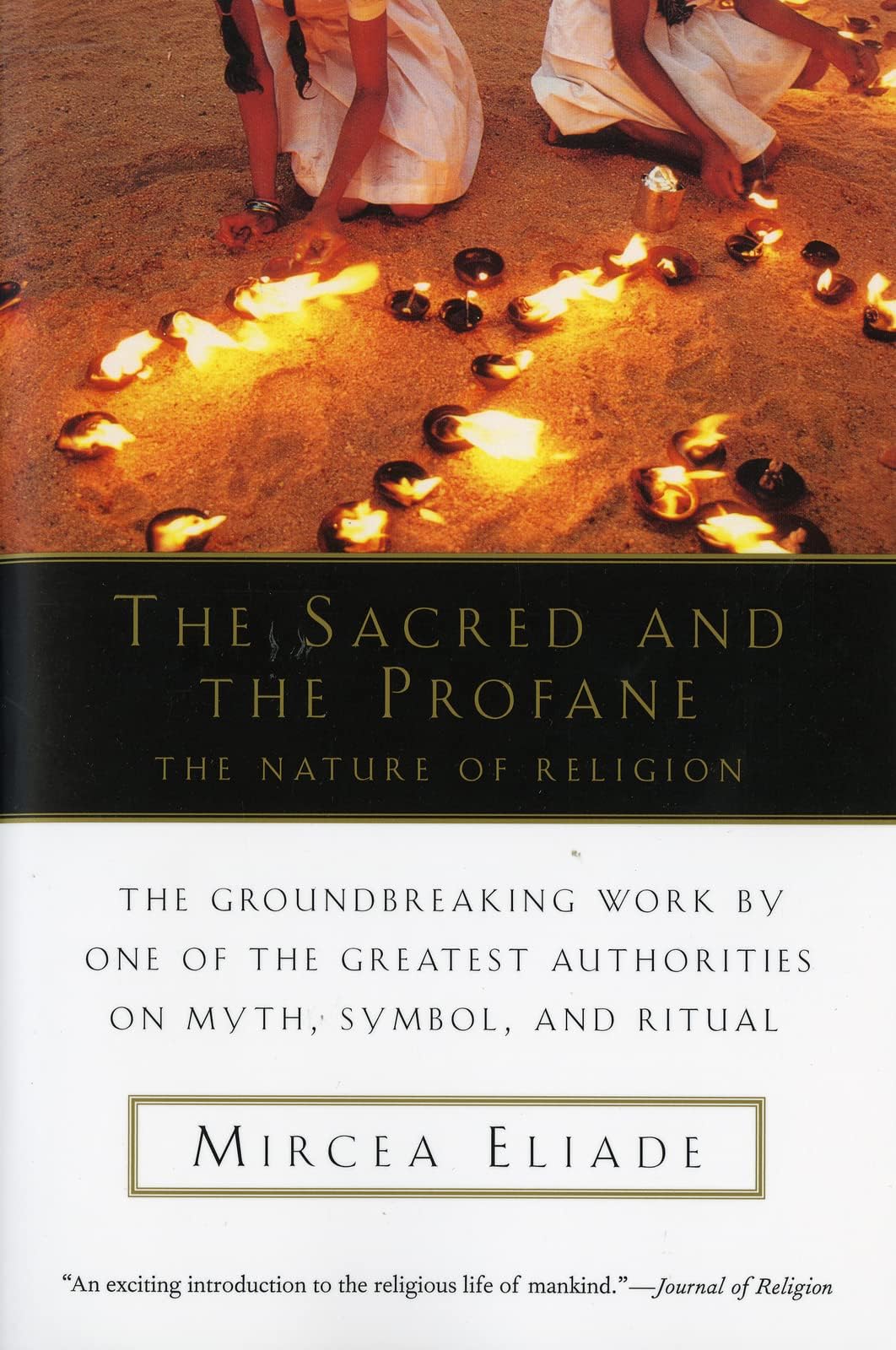
Yes, the sacred and the profane is discussed here. And guess what? They make sense. It's no secret, just sociology. Good sociology, too, none of your Discovery-Channel, sixth-tier, make every middle class viewer look down on those that are different from a Durkheim-style-deviance-arrogance and pray that they can forget just how screwed up they are kind of stuff. The good stuff. The meat, the bone and the marrow. Unapologetic, yet refined and in no way obscene. Great read. Well written, and, I can only assume, well-translated. Be warned: The cover image on Amazon is not the one that comes on the book!!! The book you get from Amazon is a new-age style cover photograph of some half-photographed "natives" playing with a circle of candles. The nifty little negative portrait of the Triune God should have stayed. It was much more appropriate to the content.
A**R
.
This book kills antitheism.
C**O
Material ruim nao comprem.
Material do livro muito ruim fonte da letra, qualidade de papel, capa do livro, o papel. Parece aqueles livros de Banca de jornal. Nao vale o preço. Procurem outra editora. NAO COMPREM.
A**E
A book recommended ...
... by Jordan B Peterson. And what an insight! "This means that the existential crisis is, finally, 'religious', since on the archaic levels of culture 'being' and 'the sacred' are one."
G**Y
What Enlightenment. This 1950's book is seminal.
$10 per copy in Australia delive red seems initially comlex & I declare no financial interest. I'm pretty cool with hard science. That's why God 'invented' Google lol I am 59 & a well read some say. Mercea is a guy I would have at "my perfect temple/dinner" with Christ, Galileo, Buddha, Socrates & ....... Spend an outrageously cheap $10 &dare to think. G.
S**T
Nice
Very nice one, one of the recommendations of Jordan Peterson, direct to the message
Trustpilot
1 month ago
1 month ago