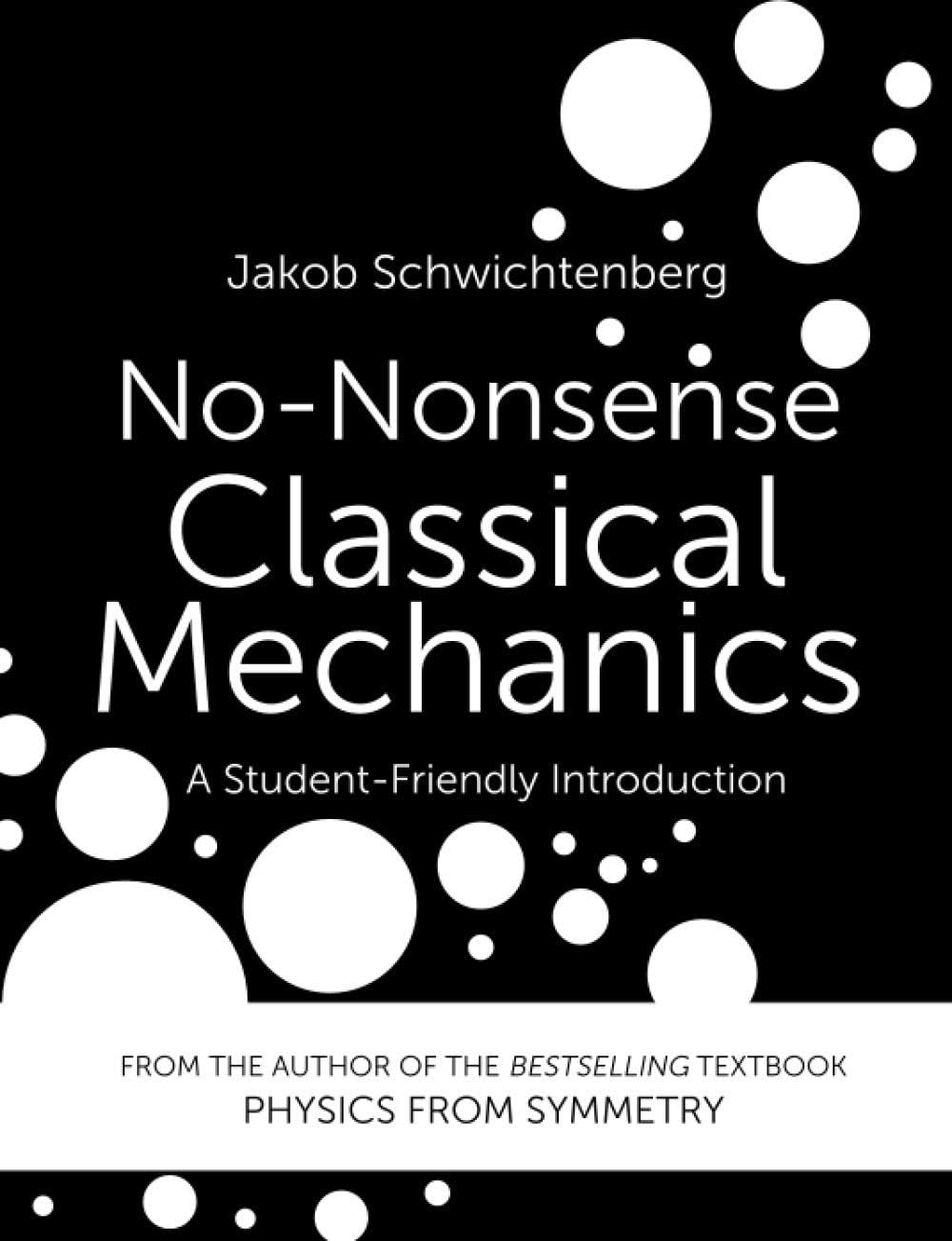

No-Nonsense Classical Mechanics: A Student-Friendly Introduction
Product ID: 345447476
Learning classical mechanics doesn't have to be hardWhat if there was a way to learn classical mechanics without all the usual fluff? What if there were a book that allowed you to see the whole picture and not just tiny parts of it?Thoughts like this are the reason that No-Nonsense Classical Mechanics now exists. What will you learn from this book?Get to know all fundamental mechanics concepts - Grasp why we can describe classical mechanics using the Lagrangian formalism, the Newtonian formalism, or the Hamiltonian formalism and how these frameworks are connected. Learn to describe classical mechanics mathematically - Understand the meaning and origin of the most important equations: Newton's second law, the Euler-Lagrange equation and Hamilton's equations. Master the most important classical mechanics systems - Read fully annotated, step-by-step calculations and understand the general algorithm we use to describe them. Get an understanding you can be proud of - Learn about beautiful and deep insights like Noether's theorem or Liouville's theorem and how classical mechanics emerges in a proper limit of special relativity, quantum mechanics and general relativity. No-Nonsense Classical Mechanics is the most student-friendly book on classical nechanics ever written. Here's why. First of all, it's nothing like a formal university lecture. Instead, it's like a casual conservation with a more experienced student. This also means that nothing is assumed to be "obvious" or "easy to see". Each chapter, each section, and each page focuses solely on the goal to help you understand. Nothing is introduced without a thorough motivation and it is always clear where each equation comes from. The book contains no fluff since unnecessary content quickly leads to confusion. Instead, it ruthlessly focuses on the fundamentals and makes sure you'll understand them in detail. The primary focus on the readers' needs is also visible in dozens of small features that you won't find in any other textbookIn total, the book contains more than 100 illustrations that help you understand the most important concepts visually. In each chapter, you'll find fully annotated equations and calculations are done carefully step-by-step. This makes it much easier to understand what's going on. Whenever a concept is used that was already introduced previously there is a short sidenote that reminds you where it was first introduced and often recites the main points. In addition, there are summaries at the beginning of each chapter that make sure you won't get lost. Review: Highly recommended - If u are a beginner, an intermediate or even an enthusiast, pls go for it. It's very much user-friendly. And thank me later ;) Review: As good as Feynman's Lectures - This book has been written with brutal honesty and humility. I enjoyed this book very much. It is for beginners in true sense. However, there is no lack of mathematical rigor. 1) Calculations are detailed, not the usual - an exercise for the student. 2) Side notes are very useful, not the usual - refer to section such and such - but the stuff is written (no flipping pages and searching) 3) Equations are cited with equations, not the usual- Eq. 5.12 - It leaves you flipping pages for no reason 4) All the doubts that generally come to mind (which may be too obvious to some - never to me) have been discussed in the text or side notes, it's very very good 5) Mathematical methods in the appendix is not only sufficient but also interesting compared to Math Methods Books 6) There are some printing errors (quite understandable, as it's only a year old) 7) Downside for me - In India, Indian print is not available, only the international print. [Goldstein costs Rs.700 and this book Rs.2500 (costly)]
| Best Sellers Rank | #773,283 in Books ( See Top 100 in Books ) #687 in Mechanics #4,373 in Physics (Books) #10,764 in Engineering & Technology (Books) |
| Customer Reviews | 4.8 out of 5 stars 256 Reviews |
A**A
Highly recommended
If u are a beginner, an intermediate or even an enthusiast, pls go for it. It's very much user-friendly. And thank me later ;)
M**D
As good as Feynman's Lectures
This book has been written with brutal honesty and humility. I enjoyed this book very much. It is for beginners in true sense. However, there is no lack of mathematical rigor. 1) Calculations are detailed, not the usual - an exercise for the student. 2) Side notes are very useful, not the usual - refer to section such and such - but the stuff is written (no flipping pages and searching) 3) Equations are cited with equations, not the usual- Eq. 5.12 - It leaves you flipping pages for no reason 4) All the doubts that generally come to mind (which may be too obvious to some - never to me) have been discussed in the text or side notes, it's very very good 5) Mathematical methods in the appendix is not only sufficient but also interesting compared to Math Methods Books 6) There are some printing errors (quite understandable, as it's only a year old) 7) Downside for me - In India, Indian print is not available, only the international print. [Goldstein costs Rs.700 and this book Rs.2500 (costly)]
I**N
Best book for Beginners
Having learnt basic Newtonian Mechanics up to high school, I thought of exploring relativity and quantum mechanics. But, the same cannot be achieved without having a grasp of Principle of Least Action, thereby leading to other formalisms of mechanics. I started reading some books on classical mechanics for a firm grasp on these concepts and even watched a few videos. But, I could get a hold on these topics only after I laid hands on this superbly written book. It explains the concepts in such a lucid way as if the author is directly communicating with you. For a beginner, this is the best book.
P**R
One of the best book I have ever read .
If you want to understand core concepts of classical mechanics, this book is for you. This book is even accessible to high school students.
N**E
An extraordinary book!
Jacob has done a great job! His writing is lucid and clear. He has explained many concepts of classical mechanics in extraordinary way. The book contains lots of figure to aid the concept more effectively!
S**N
Brilliant book. Deep exposition. Concise, clear and zero fluff. Binge-worthy.
My background: I'm a current PhD Physics entrant, in India. I have a working/textbook idea (basic problem solving) of the famous formalisms of classical mechanics (Newtonian, Lagrangian and Hamiltonian). But have a rather weak understanding of the formalisms and the deeper meaning. What this book claims to achieve, and does so perfectly: First of all, the language is simple without any compromise of physical rigor. The author takes a physics-first approach throughout, without killing the necessary mathematics. It gives a deeper understanding of the fundamentals of various formalisms. (The Lagrangian and Hamiltonian formalisms have been covered in super depths, conveying clearly the ideas and motivations.) It does not take for granted the reader's familiarity with any topic including basic calculus. (But a little previous exposure will come in greatly handy, in my opinion) It introduces other lesser known formalisms/ideas (Koopman von Neuman, Hamilton-Jacobi and Liouville theorem from a statistical mechanics perspective) in passing, but correctly so. The idea of symmetry (Noether's theorem) is introduced in a crystal clear manner and lays the foundation for the latter part of the book which explains the origins of classical mechanics (especially the least action principle) from more fundamental theories (Special relativity, general relativity and path intergral formalism of quantum mechanics). And all of it explained beautifully that even a high school student can gain strong insights. What it does not claim to do (and does not do): It is not a problem filled book! The applications of ideas are kept to a bare minimum. (Although, included are few classic examples of how to approach an application using a given formalism.) For solving problems and more conventional routes of learning, the author has added a set of excellent references in the book. Note: There are some typos occasionally, but nothing too dramatic that you can't follow or correct for yourself. The author has a website (link provided in the book) and is constantly notified by readers regarding such typos and misprints. Best part is the author takes the feedback seriously and updates the book regularly. The author also has Electrodynamics, Quantum Mechanics and Quantum Field Theory books which run on the same vein as this one and equally exceptional. I felt that with prior basic exposure to the subjects, one can master the essentials of these books in less than a week each. Definitely more learning in a week than in 5 years of an average Indian University. Happy reading.
T**L
A masterpiece of a science education book
This work is a revelation for learning a mathematical topic from a book. With the clever tricks of writing out the transforms applied in every line of a derivation and the repetition of important concepts you can just read this book like a popular science book. It works if you read a chapter or two every other evening but you gain an understanding similar to a few years after attending a lecture on this topic and not accustomed with calculating stuff anymore but deeply familiar what all the equations mean. I do recommend this book highly but also the whole no-nonsense series. However, so far I believe this is the best out of the series - but I still need to read the quantum field theory book.
M**S
Fantastic fantastic fantastic
Wow what an amazing book. For me as someone who wants to understand how the world works but isn't especially interested in doing a ohysics course at university the world has been a difficult place. Pop science books cover a lot of modern physics but mostly in an unsatisfying manner that doesn't help understand why things are. University level textbooks give the correct information but are cluttered with extra information not really important to my quest (though obviously essential if you actually want to be a physicist. Leonard Susskind with his Theoretical Minimum series opened the door for me by explaining the mathematics without the clutter. This was a huge step forward for me. But there was something missing from these that I wasn't entirely satisfied. Jakob Schwichtenberg provides the exact answer to the problem. Anyone looking to understand modern classical mechanics (and therefore take the first necessary step towards understanding modern physics) but who doesn't want to do a ohysics degree; here is your answer. He takes Susskind's Idea of cutting out the cruft and the problem solving techniques and focuses on the key to understanding how the world works. But what this book adds is a beautifully structured way of understanding. The way he groups the 3 arenas to give the three formulations of classical mechanics (Newtonian, Lagrangian, Hamiltonian) was a game changer. Suddenly I could see how everything fit together and related back and forth. That in itself was worth the purchase price. But what makes this one of the best (if not the best) science books I've ever read is the explanations of how the Action principle and Lagrangians come to be. I feel like my understanding made a quantum leap. Also exceptional are his derivations and general handling of the maths. Every single line is explained. There are no sudden leaps that require you to work out 3 pages of maths or remember an equation you saw 50 pages ago. Everything is referenced, explained and often restated where it is used. So if you want to understand modern physics at a deep level but don't want to do a degree - or even if you are doing a degree because this gives structure to the random seeming things taught there - buy this book. You won't regret it. I've already bought the other books in the series and can't wait to read them.
F**T
Phenomenal
Phenomenal book. The author is really good at distilling the theory into the most essential concepts and applying them to simple systems to help the reader understand the core ideas (you're not overwhelmed with complex examples). Calculations are given with many details and you're not lost in physics jargon. I wasn't sure if this book would be a gimmick at first, but I'm happy to say it isn't. The comments and pictures are helpful too. As a mathematician, I found the presentation to be extremely clear and pleasant, which is pretty much the opposite I experienced whenever I tried to delve into other physics publications.
Q**9
a broad outlook
I received this book only recently, and have not studied it seriously yet, but I have had a quick look. My impression is that it reads easily, has a broad coverage, is profusedly illustrated, and has an interesting style of instruction that is quite appealing to self-study.
A**V
C'est le meilleur livre d'introduction à la méchanique classique que vous puissiez trouver
Dire que c'est le meilleur livre d'introduction que vous pouvez trouver peut sembler exagéré, car évidemment il n'y a pas de "meilleur livre" du point de vue objectif, qui convienne à tout le monde à 100%. Cependant, ce livre est très proche de cet idéal impossible car il possède des caractéristiques vraiment uniques que aucun autre livre n'a (du moins ceux que j'ai lus, et il y en a beaucoup !) Langage unique : Le langage de ce livre est exceptionnellement décontracté, accessible, non intimidant et adapté aux étudiants, ce qui rend sa lecture très agréable et fluide. Tout cela, bien sûr, sans sacrifier la rigueur ou le contenu nécessaire. Style d'enseignement unique : L'auteur a un talent exceptionnel pour expliquer des choses compliquées de manière accessible. On voit à chaque page que son seul objectif est de faire comprendre au lecteur ce qu'il lit. Présentation unique des dérivations mathématiques : Les dérivations sont si bien présentées et les détails sont systématiquement donnés pour chaque étape (et même sous-étape) que vous avez une garantie à 100% de ne jamais rester bloqué dans une dérivation. Je n'ai jamais vu un tel niveau de détail dans aucun textbook existant, c'est vraiment unique et utile, surtout pour les personnes ayant des connaissances mathématiques plus limitées. Une caractéristique exceptionnelle dans un tel livre. Expérience de lecture unique : Tout textbook, même le plus intéressant et le plus adapté aux étudiants dans son style, peut parfois être "ennuyeux", simplement parce que c'est un textbook. Celui-ci se lit vraiment comme un roman. Je ne pensais pas que cela était possible avant de découvrir ce livre. L'auteur rend tout passionnant parce qu'il est tellement passionné par le sujet lui-même ! Choix unique du contenu : L'auteur a fait des choix concernant ce qu'il inclut et ce qu'il exclut de son livre. Ici, nous n'avons que les fondamentaux et aucune application complexe que l'on pourrait trouver dans d'autres livres sur le sujet. Mais les fondamentaux sont expliqués avec un niveau de détail et de profondeur de compréhension sans précédent. Un traitement aussi approfondi du sujet dans un livre d'introduction est vraiment unique. Cela donne au lecteur l'occasion de comprendre des choses que l'on comprend généralement à partir de livres beaucoup plus avancés. Ce choix de contenu et la manière de le présenter par l'auteur sont un pur génie.
Trustpilot
1 day ago
3 weeks ago