Some deliveries may take a little longer than usual due to regional shipping conditions.

DOWNLOAD THE APP


Customer Services
Copyright © 2025 Desertcart Holdings Limited
DOWNLOAD THE APP
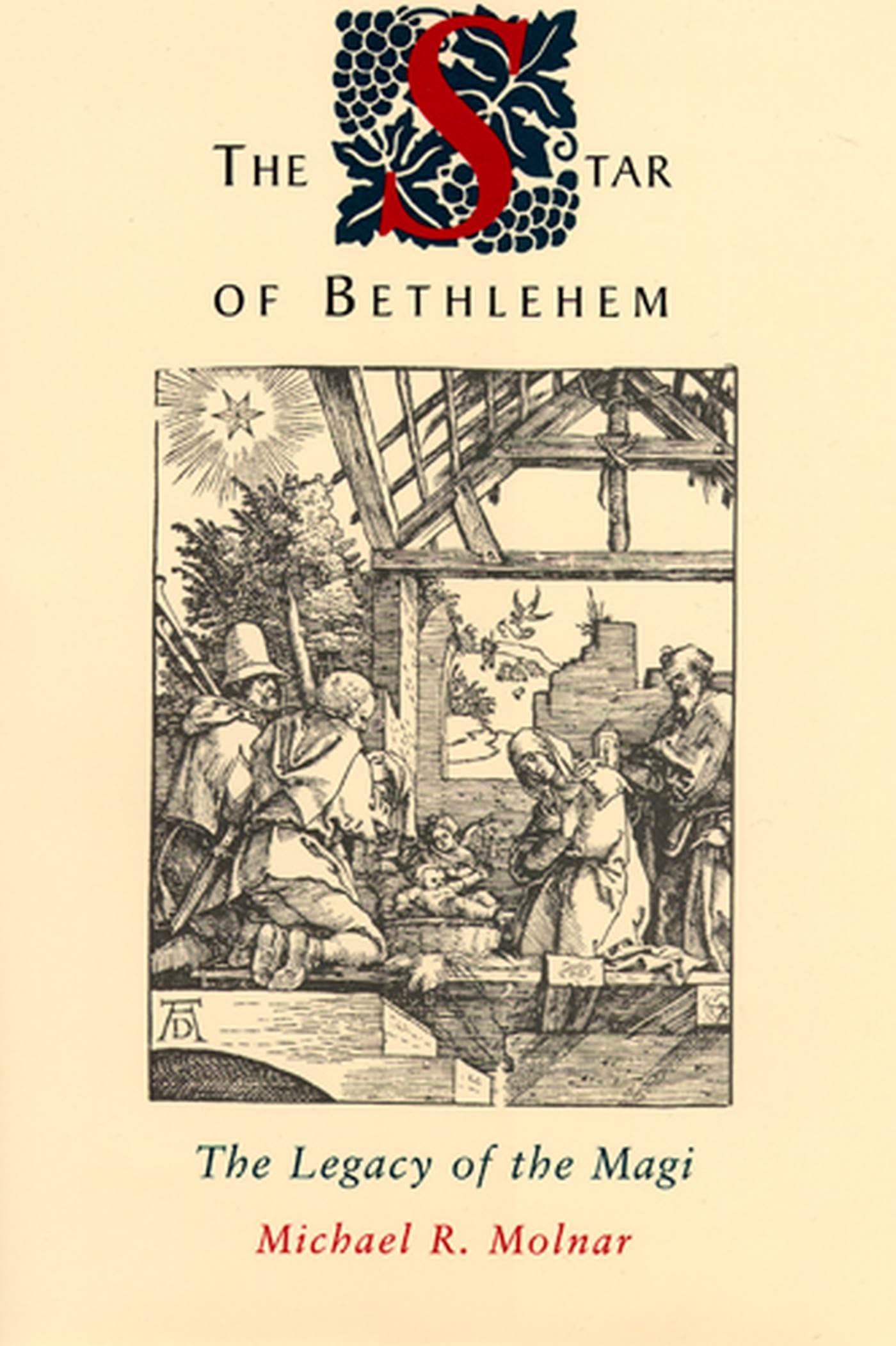
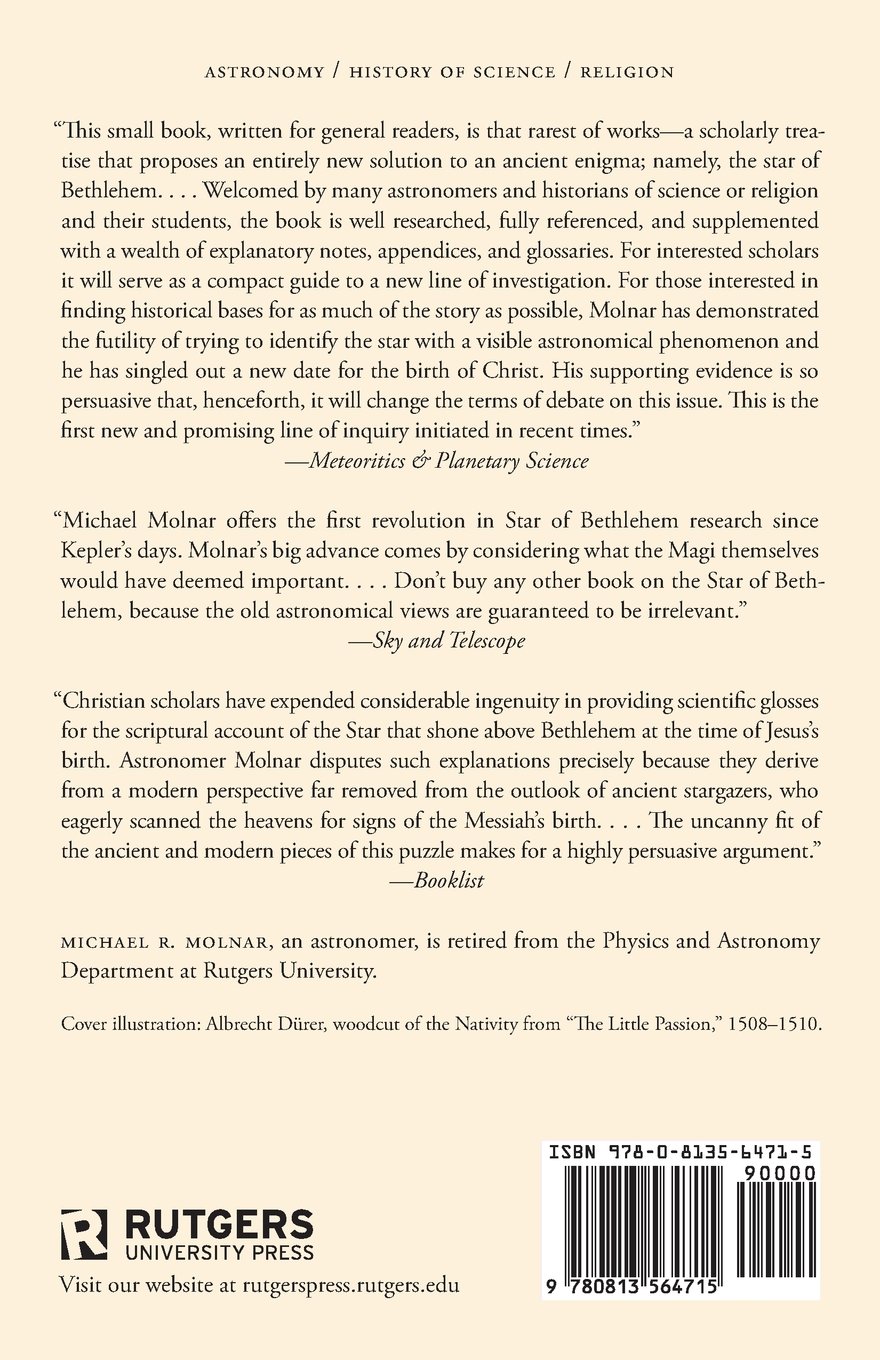

The Star of Bethlehem: The Legacy of the Magi [Molnar, Michael R.] on desertcart.com. *FREE* shipping on qualifying offers. The Star of Bethlehem: The Legacy of the Magi Review: Is it April 17, 6 BC? - Professional astronomer Michael Molnar's "The Star of Bethlehem: The Legacy of the Magi" (2000) is destined to become a classic in star studies. This 187-page (hardback) book is well documented with 16 informative pages of endnotes, a helpful 11-page glossary, and a 5-page chronology. Molnar also completes this work with an interesting 9-page appendix entitled "Defining the Position of the Zodiac". This fascinating book was a quick read for me (I completed it in only a few days). I've also noticed that much of the information herein has been featured on various television documentaries about history's most famous star. I have used its material often in discussions, and for teaching, about Christ's Nativity. From an ancient numismatic study, Molnar suggests that the arrival of the Magi to Jerusalem and then later in Bethlehem (Matthew 2) may be pinpointed with certain amount of accuracy. Syrian coins, minted just before the birth of Christ, sport a ram together with a star. This coinage discovery led Molnar to consider the power of the star in the world of late antiquity. Documenting (from ancient star charts and other records) Jupiter as the royal planet in the ancient mind and Aries (the Ram) as a symbol of Judah in the ancient Zodiac, Molnar identifies Jupiter's passage through Aries (in the western sky) during the spring of 6 B.C. (chapter 4). This portent may have convinced the Magi (as avid stargazers east of Palestine) of an immanent regal birth in Israel (page 101). Molnar's extensive research among the ancient documents leads him to an exciting conclusion- the Magi arrival occurred on April 17, 6 B.C. (the date Jupiter was most prominent to the naked eye in Aries)! Could this date be Jesus of Nazareth's birthday? Molnar seems convinced. Molnar also talks about various ancient topics (i.e. the Roman Saturnalia, the origins for the official date for Christmas as December 25th, the dating of Herod the Great's death, and much more). The book, additionally, offers several black and white ancient coin photos, a number of ancient zodiac/star charts, maps and drawings of key people from his research. Molnar's writing style is non technical and persuasive. His coin study is fascinating and the star charts are informative. This is an excellent book and a good gift candidate. It is recommended to all astronomy buffs, teachers, Bethlehem star studiers, students of late antiquity, biblical researchers, and history readers. Order your copy soon. Review: A novel approach to a perennial enigma. - The Star of Bethlehem is a perennially favorite topic for planetarium shows, articles, musings, sermons, and books. What could be left at this late date to say about it? Quite a lot, actually. Enough so that two new books, both titled "The Star of Bethlehem" (How original!) and both copyright 1999 are on my desk as I write. The story about the Star is found only in the Gospel of Matthew. There are three possibilities: 1) The star was a myth - invented by the writer of Matthew or earlier Christians whom he followed, in order to give Jesus appropriately royal auspices for his birth. 2) The star was a miracle provided by God to guide the Magi, even perhaps visible only to them. 3) The star was a natural astronomical event or events. These three are obviously mutually exclusive and exhaustive. If either of the first two possibilities are correct, there is little more to be said; therefore both of our authors give them short shrift. Both books cover some of the same material in about the same way. Jesus was *not* born on December 25 of 1 BC as worked out by the Scythian monastic scholar Dionysius Exiguus (Denny the Dwarf) in 525 AD. King Herod, of whom the Magi inquired about the birth, died in 4 BC. For other reasons, the birth is fairly firmly dated to between 6 and 4 BC. If the shepherds were `abiding with their flocks by night', the birth did not take place in December. For various reasons, these authors agree that Spring is more likely. "The Star of Bethlehem - An Astronomer's View", by Mark Kidger, gives a review of all the various suggestions that have been made over the years, finally settling on a combination of events being the sign: a triple conjunction of Jupiter and Saturn in Pisces (the sign Kidger says is associated with the Jews - more on this later) between May and December of 7 BC, with Mars approaching this pair in February of 6 BC, followed by a near-occultation of Jupiter by the Moon in Pisces in February of 5 BC, and then, possibly a nova in March/April 5 BC, as suggested by some Korean and Chinese records. I would have found this scenario plausible were it not for the second, and to my mind more interesting, book: "The Star of Bethlehem - The Legacy of the Magi" by Michael R. Molnar. There are two problems, as pointed out by Molnar, with the kinds of solutions reviewed, and those eventually suggested, by Kidger. Firstly, they tend to focus on what we as moderns would find to be visually compelling sights in the heavens. But this neglects the fact that the Magi were certainly *astrologers*, most likely Hellenistic rather than Babylonian in their astrological theories. Most of the events put forward would not have been significant to contemporary astrology. Kidger himself makes this point but does not seem to follow through with a close study of Hellenistic astrology as Molnar has made. Secondly, we have the advantage over the Magi of *knowing*, at least approximately, what the correct time frame is, then sifting through a small number a years to find the most significant events during those years. We have to imagine an ongoing community of astrologers, scanning the skies for generations perhaps, and imagine what would have been absolutely unique over many years, and compelling enough to make them undertake an arduous journey. In this light, Kidger's series of events are not so special. Molnar made a key discovery, beginning with a study of ancient coins, which often incorporated astrological symbols, that Aries was the constellation contemporary astrologers believed controlled the Levant, of which Judea was a part. The identification of Pisces with the Jews is Medieval and hence anachronistic in this context. When the Magi say "...we have seen his star in the east...", they would have been referring to the helical rising of a star or planet - that is, when it is newly visible in the morning sky rising ahead of the sun. Jupiter had its heliacal rising on April 17 of 6 BC in Aries. On that same day, the moon occulted Jupiter for the second time in a row (previously on March 20). This would have greatly increased the astrological significance of kingly Jupiter. Molnar covers about half a dozen other astrological portents for this day, involving rulers of the trines, exaltations, attendance, and beneficent planets, that space does not permit me to explain in detail. In terms of astrological import, this day is absolutely unique for hundreds of years, and Molnar makes a strong case, to my mind, that he has indeed found the origin of the curious story in Matthew. Astronomers tend to be instantly dismissive of anything having to do with astrology, even to the extent of neglecting its proper application to a historical problem such as this one. Astrology, like it or not, is an important part of the history of human thought, and of the history of astronomy itself, which grew out of it. Michael Molnar is to be congratulated for shedding light on this ancient way of thinking.

| Best Sellers Rank | #685,902 in Books ( See Top 100 in Books ) #898 in Astronomy (Books) #1,167 in Christology (Books) #1,177 in History of Religions |
| Customer Reviews | 4.6 4.6 out of 5 stars (80) |
| Dimensions | 5.5 x 0.5 x 8.5 inches |
| Edition | First Paperback Edition, Updated with a new preface |
| ISBN-10 | 0813564719 |
| ISBN-13 | 978-0813564715 |
| Item Weight | 9 ounces |
| Language | English |
| Print length | 208 pages |
| Publication date | September 20, 2013 |
| Publisher | Rutgers University Press |
R**S
Is it April 17, 6 BC?
Professional astronomer Michael Molnar's "The Star of Bethlehem: The Legacy of the Magi" (2000) is destined to become a classic in star studies. This 187-page (hardback) book is well documented with 16 informative pages of endnotes, a helpful 11-page glossary, and a 5-page chronology. Molnar also completes this work with an interesting 9-page appendix entitled "Defining the Position of the Zodiac". This fascinating book was a quick read for me (I completed it in only a few days). I've also noticed that much of the information herein has been featured on various television documentaries about history's most famous star. I have used its material often in discussions, and for teaching, about Christ's Nativity. From an ancient numismatic study, Molnar suggests that the arrival of the Magi to Jerusalem and then later in Bethlehem (Matthew 2) may be pinpointed with certain amount of accuracy. Syrian coins, minted just before the birth of Christ, sport a ram together with a star. This coinage discovery led Molnar to consider the power of the star in the world of late antiquity. Documenting (from ancient star charts and other records) Jupiter as the royal planet in the ancient mind and Aries (the Ram) as a symbol of Judah in the ancient Zodiac, Molnar identifies Jupiter's passage through Aries (in the western sky) during the spring of 6 B.C. (chapter 4). This portent may have convinced the Magi (as avid stargazers east of Palestine) of an immanent regal birth in Israel (page 101). Molnar's extensive research among the ancient documents leads him to an exciting conclusion- the Magi arrival occurred on April 17, 6 B.C. (the date Jupiter was most prominent to the naked eye in Aries)! Could this date be Jesus of Nazareth's birthday? Molnar seems convinced. Molnar also talks about various ancient topics (i.e. the Roman Saturnalia, the origins for the official date for Christmas as December 25th, the dating of Herod the Great's death, and much more). The book, additionally, offers several black and white ancient coin photos, a number of ancient zodiac/star charts, maps and drawings of key people from his research. Molnar's writing style is non technical and persuasive. His coin study is fascinating and the star charts are informative. This is an excellent book and a good gift candidate. It is recommended to all astronomy buffs, teachers, Bethlehem star studiers, students of late antiquity, biblical researchers, and history readers. Order your copy soon.
M**R
A novel approach to a perennial enigma.
The Star of Bethlehem is a perennially favorite topic for planetarium shows, articles, musings, sermons, and books. What could be left at this late date to say about it? Quite a lot, actually. Enough so that two new books, both titled "The Star of Bethlehem" (How original!) and both copyright 1999 are on my desk as I write. The story about the Star is found only in the Gospel of Matthew. There are three possibilities: 1) The star was a myth - invented by the writer of Matthew or earlier Christians whom he followed, in order to give Jesus appropriately royal auspices for his birth. 2) The star was a miracle provided by God to guide the Magi, even perhaps visible only to them. 3) The star was a natural astronomical event or events. These three are obviously mutually exclusive and exhaustive. If either of the first two possibilities are correct, there is little more to be said; therefore both of our authors give them short shrift. Both books cover some of the same material in about the same way. Jesus was *not* born on December 25 of 1 BC as worked out by the Scythian monastic scholar Dionysius Exiguus (Denny the Dwarf) in 525 AD. King Herod, of whom the Magi inquired about the birth, died in 4 BC. For other reasons, the birth is fairly firmly dated to between 6 and 4 BC. If the shepherds were `abiding with their flocks by night', the birth did not take place in December. For various reasons, these authors agree that Spring is more likely. "The Star of Bethlehem - An Astronomer's View", by Mark Kidger, gives a review of all the various suggestions that have been made over the years, finally settling on a combination of events being the sign: a triple conjunction of Jupiter and Saturn in Pisces (the sign Kidger says is associated with the Jews - more on this later) between May and December of 7 BC, with Mars approaching this pair in February of 6 BC, followed by a near-occultation of Jupiter by the Moon in Pisces in February of 5 BC, and then, possibly a nova in March/April 5 BC, as suggested by some Korean and Chinese records. I would have found this scenario plausible were it not for the second, and to my mind more interesting, book: "The Star of Bethlehem - The Legacy of the Magi" by Michael R. Molnar. There are two problems, as pointed out by Molnar, with the kinds of solutions reviewed, and those eventually suggested, by Kidger. Firstly, they tend to focus on what we as moderns would find to be visually compelling sights in the heavens. But this neglects the fact that the Magi were certainly *astrologers*, most likely Hellenistic rather than Babylonian in their astrological theories. Most of the events put forward would not have been significant to contemporary astrology. Kidger himself makes this point but does not seem to follow through with a close study of Hellenistic astrology as Molnar has made. Secondly, we have the advantage over the Magi of *knowing*, at least approximately, what the correct time frame is, then sifting through a small number a years to find the most significant events during those years. We have to imagine an ongoing community of astrologers, scanning the skies for generations perhaps, and imagine what would have been absolutely unique over many years, and compelling enough to make them undertake an arduous journey. In this light, Kidger's series of events are not so special. Molnar made a key discovery, beginning with a study of ancient coins, which often incorporated astrological symbols, that Aries was the constellation contemporary astrologers believed controlled the Levant, of which Judea was a part. The identification of Pisces with the Jews is Medieval and hence anachronistic in this context. When the Magi say "...we have seen his star in the east...", they would have been referring to the helical rising of a star or planet - that is, when it is newly visible in the morning sky rising ahead of the sun. Jupiter had its heliacal rising on April 17 of 6 BC in Aries. On that same day, the moon occulted Jupiter for the second time in a row (previously on March 20). This would have greatly increased the astrological significance of kingly Jupiter. Molnar covers about half a dozen other astrological portents for this day, involving rulers of the trines, exaltations, attendance, and beneficent planets, that space does not permit me to explain in detail. In terms of astrological import, this day is absolutely unique for hundreds of years, and Molnar makes a strong case, to my mind, that he has indeed found the origin of the curious story in Matthew. Astronomers tend to be instantly dismissive of anything having to do with astrology, even to the extent of neglecting its proper application to a historical problem such as this one. Astrology, like it or not, is an important part of the history of human thought, and of the history of astronomy itself, which grew out of it. Michael Molnar is to be congratulated for shedding light on this ancient way of thinking.
J**I
EXCELLENT--EVERY Christian should read it, for FACTS not MYTHS
Unfortunately, modern Christianity has a HUGE amount of "revisionist history backstories", such as "Candy Canes are Christian Symbols--they're curved to be J for Jesus, white to symbolize purity, 3 red stripes represent the Trinity." NO!--check Snopes. No, the Magi didn't see a star--others would have seen it and written about it. And there's no way they could say "THAT star is over THAT house." Romans recognized comets. Meteors are only visible a few minutes. No it wasn't "a shining angel"--again, others would have seen it and written about it. Molnar shows with CLEAR AND CONVINCING HISTORICAL EVIDENCE that what they were "seeing" was an ASTROLOGICAL CHART. He goes into detail about HOW PERVASIVE beliefs in astrology were at the time--AN ASPECT OF BIBLICAL-ERA CULTURE NEVER STUDIED OR MENTIONED IN CHRISTIAN CIRCLES. EVEN IF SOMETHING IS FALSE, if people BELIEVE it their belief affects their ACTIONS--such as traveling to another country because of a belief that a horoscope shows a great king will be born ... Regarding the claim some folks will make, "But doesn't the fact that a great king WAS born PROVE astrology?", no, because as Molnar points out there was Chinese astrology, Persian astrology, Babylonian astrology, Greek astrology, etc.,--and each system made different predictions.
F**N
Super important study material for the curiously crazy like me
Spoiler alert: This book explains that the “star” is actually Jupiter as divined by ancient astronomers astrologers wise men. Super convincing argument! Now I’m a believer, and I know God is beyond human understanding. Highly recommended read!
K**R
Three Stars
Interesting read, but I can't say I agree with all of it.
S**P
This book is well written and there can be little doubt that the authors knows his subject. At times the astronomical descriptions can be a bit dry but in the end – for all those who hang on with the author till the end – will discover that the effort was well worth it. This is one of the better books on the subject as the author surely knows what he is talking about. He makes a good case for the 6 BC event. Whether or not this date is finally accepted or not, this book cannot be simply ignored. I highly recommend it.
A**R
This book is a thorough study of the indicators of the star of Bethlehem. It covers the constellations, novas, eclipses, and conjunctions. Their astrological meanings are examined, and the conclusion is that Jesus was born at a conjunction in April of 6 BC. Astrology is a lost key to the prophecy of Jesus birth.
R**R
Very interesting .. perhaps - at last - the final solution to the identity of the Star of Bethlehem? Although I have no time for astrology in today's world, it makes a lot of sense to me that Michael Molnar should proceed by investigating what would have been thought by those who studied the stars at the time of Jesus. I found the description of the retrograde motion of Jupiter and what it meant to the ancient astrologers very compelling - and convincing. Thanks Dr Molnar! for a scholarly and accessible book ___ RECOMMENDED ___ and readable for those with limited astronomy background too. (Make sure you get the 2013 edition, with the revised preface).
S**A
Book exactly as described & pictured. Took longer than I expected for it to arrive, but it got here in good condition.
R**T
Again Excellent
Trustpilot
1 month ago
1 month ago