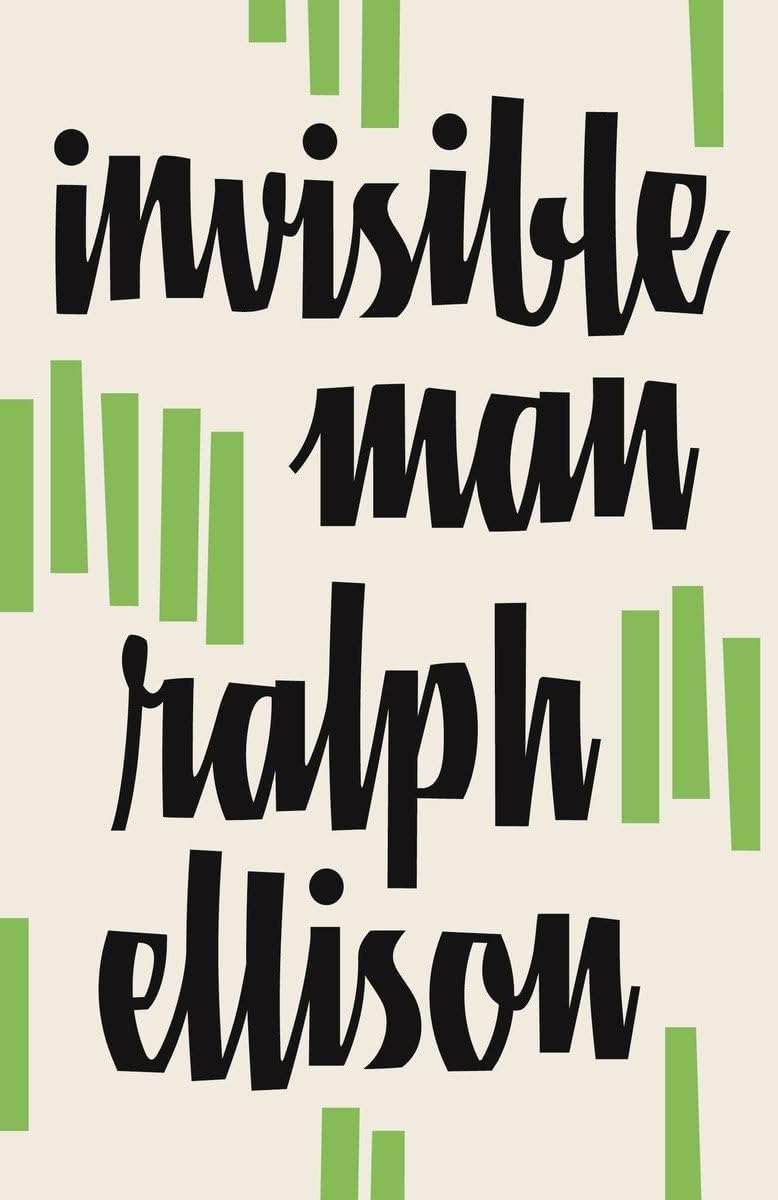
Invisible Man
Product ID: 1966338
Buy anything from 5,000+ international stores. One checkout price. No surprise fees. Join 2M+ shoppers on Desertcart.
Desertcart purchases this item on your behalf and handles shipping, customs, and support to Botswana.
NATIONAL BOOK AWARD WINNER • NATIONAL BESTSELLER • In this deeply compelling novel and epic milestone of American literature, a nameless narrator tells his story from the basement lair of the Invisible Man he imagines himself to be. One of The Atlantic ’s Great American Novels of the Past 100 Years He describes growing up in a Black community in the South, attending a Negro college from which he is expelled, moving to New York and becoming the chief spokesman of the Harlem branch of "the Brotherhood," before retreating amid violence and confusion. Originally published in 1952 as the first novel by a then unknown author, it remained on the bestseller list for sixteen weeks and established Ralph Ellison as one of the key writers of the century. The book is a passionate and witty tour de force of style, strongly influenced by T.S. Eliot's The Waste Land , James Joyce, and Dostoevsky. Review: One of the most important American novels of the 20th century - I just reread this novel, not having touched it since 1994, and was once again impressed at Ellison's abilities as a storyteller, an observer, a thinker, and a prose stylist. I found myself (as I did 20 years ago and in the 1970s when I first read it) stopping frequently to reflect, to retrace my thoughts, and to think hard about all the things this book is about. In short, this is a serious novel for serious readers. While clearly this is a novel about race and identity, it transcends those two very common themes in American literature. It challenges both the racial politics prevailing in the American South and the liberal politics (and Marxist politics) of the supposedly more enlightened North, exposing both to be merely implements of people (both black and white) who use them for personal power and gain. Among the many things I love about this novel is that it challenges the usual pattern of the Bildungsroman, the growth of the central character into some kind of disillusioned authenticity. The last chapter of Invisible Man, along with the epilogue, suggest that such a state of autonomy is a goal that always remains elusively ahead of us, receding into the distance as we try to close on it. And so the novel interrogates both the idea of racial identity and the Emersonian ideal of individuality (the two are often counterpoised in discussion of affirmative action, for instance, and the novel reveals how complicated and tangled both ideas are in practice). Ellison's prose can at times be difficult, but it is worth careful attention. Its rhythms are beautiful and at times hypnotizing, and his play with words and with myth -- arguably this is a rewritten Odyssey -- is always thought provoking. Moreover, while incorporating a number of character types -- Norton, Bledsoe, Emerson, Jack, Mary, Ras, and even Rinehart all represents kinds of people I know of -- each comes across as an idiosyncratic individual, each neatly developed through revealing specifics. This novel is obviously the product of both genius and master craftsmanship. The Vintage edition is very good -- for one thing, it includes the prologue and epilogue (I've learned that some editions, sadly, omit them). The quality of the paper and the binding hold up well; it's important to me that a book feel right in my hands and this one feels great. I'm surprised that neither the Library of America nor the Norton Critical Editions have produced editions of this work. It is worthy of either series, and much wider exposure. It is without question one of the most important American novels of the 20th century. Review: A MUST READ - With my being so finicky about the books I choose to read, I have relatively high expectations for what lies within each one. I've seen this book for awhile now, and on many recommended reads within Black Literature. With such a vague cover and an even more ambiguous title, I found myself constantly overlooking it without realizing that I had seen this book right in front of me time and time again, as I searched for my next enlightening piece of history. I realize now with the book being so inconspicuous, that the title itself is actually quite fitting. Prior to reading Invisible Man, I hadn't heard much about it. No recommendations or opinions from others. So there was no way for me to foresee the impact the story would have on me. No way to envisage how eventful and substantial this book would be. No way to anticipate the perspective given to me, from the author, of this black man in America. No way for me to expect the change made to MY perspective as a Black American. After experiencing this painful truth, there was no way I could have conceived that the very people in my life may be "Invisible," and that I myself am invisible as well. The protagonist did not expect to experience the harsh realities of his existence. More specifically, to experience a journey that he had not planned for, but had plans for him; to meet with a number of individuals that would alter his perspective on being black in a white country; not expecting to ultimately realize that he never accurately knew himself in the first place. The Invisible Man struggles to live in a world where people choose to see him as THEY want to see him, and not for who he truly is. I felt deeply connected with both the mental plight of the protagonist, and his lonesome walk of life. Author Ralph Ellison paints the most vivid picture of an incredible story. With it's outstanding descriptiveness, and incredible symbolism, this book is nothing short of a masterpiece. While it may be tough to grasp all of it's messages and comprehend each metaphor in one read, it's a page turning experience that unforgivably takes a hold of your emotions without ever letting go. This book is an essential read for a number of reasons, however, two of them strike me as the most palpable. The first being its accurate portrayal of racism in America. Ellison takes us inside the mind of the protagonist as he experiences and discovers hateful discrimination in many forms. As well as many perspectives on racism though multiple characters in the book. And second, though it goes without saying how well written and beautiful the novel is, I was astounded by the overall genius of Ellison's vision. With how meticulous and well crafted this work of art is, it came as no surprise when I learned that it took Ellison roughly seven years to complete this book. The ideas presented in this book, though written nearly 70 years ago, still resonate deeply in today's society. I consider myself fortunate to have graced its pages. Easily a 5 star book, and one of the best books I've ever read.


| Best Sellers Rank | #5,486 in Books ( See Top 100 in Books ) #5 in Literary Criticism & Theory #56 in Contemporary Literature & Fiction #247 in Classic Literature & Fiction |
| Customer Reviews | 4.5 out of 5 stars 8,741 Reviews |
J**N
One of the most important American novels of the 20th century
I just reread this novel, not having touched it since 1994, and was once again impressed at Ellison's abilities as a storyteller, an observer, a thinker, and a prose stylist. I found myself (as I did 20 years ago and in the 1970s when I first read it) stopping frequently to reflect, to retrace my thoughts, and to think hard about all the things this book is about. In short, this is a serious novel for serious readers. While clearly this is a novel about race and identity, it transcends those two very common themes in American literature. It challenges both the racial politics prevailing in the American South and the liberal politics (and Marxist politics) of the supposedly more enlightened North, exposing both to be merely implements of people (both black and white) who use them for personal power and gain. Among the many things I love about this novel is that it challenges the usual pattern of the Bildungsroman, the growth of the central character into some kind of disillusioned authenticity. The last chapter of Invisible Man, along with the epilogue, suggest that such a state of autonomy is a goal that always remains elusively ahead of us, receding into the distance as we try to close on it. And so the novel interrogates both the idea of racial identity and the Emersonian ideal of individuality (the two are often counterpoised in discussion of affirmative action, for instance, and the novel reveals how complicated and tangled both ideas are in practice). Ellison's prose can at times be difficult, but it is worth careful attention. Its rhythms are beautiful and at times hypnotizing, and his play with words and with myth -- arguably this is a rewritten Odyssey -- is always thought provoking. Moreover, while incorporating a number of character types -- Norton, Bledsoe, Emerson, Jack, Mary, Ras, and even Rinehart all represents kinds of people I know of -- each comes across as an idiosyncratic individual, each neatly developed through revealing specifics. This novel is obviously the product of both genius and master craftsmanship. The Vintage edition is very good -- for one thing, it includes the prologue and epilogue (I've learned that some editions, sadly, omit them). The quality of the paper and the binding hold up well; it's important to me that a book feel right in my hands and this one feels great. I'm surprised that neither the Library of America nor the Norton Critical Editions have produced editions of this work. It is worthy of either series, and much wider exposure. It is without question one of the most important American novels of the 20th century.
M**2
A MUST READ
With my being so finicky about the books I choose to read, I have relatively high expectations for what lies within each one. I've seen this book for awhile now, and on many recommended reads within Black Literature. With such a vague cover and an even more ambiguous title, I found myself constantly overlooking it without realizing that I had seen this book right in front of me time and time again, as I searched for my next enlightening piece of history. I realize now with the book being so inconspicuous, that the title itself is actually quite fitting. Prior to reading Invisible Man, I hadn't heard much about it. No recommendations or opinions from others. So there was no way for me to foresee the impact the story would have on me. No way to envisage how eventful and substantial this book would be. No way to anticipate the perspective given to me, from the author, of this black man in America. No way for me to expect the change made to MY perspective as a Black American. After experiencing this painful truth, there was no way I could have conceived that the very people in my life may be "Invisible," and that I myself am invisible as well. The protagonist did not expect to experience the harsh realities of his existence. More specifically, to experience a journey that he had not planned for, but had plans for him; to meet with a number of individuals that would alter his perspective on being black in a white country; not expecting to ultimately realize that he never accurately knew himself in the first place. The Invisible Man struggles to live in a world where people choose to see him as THEY want to see him, and not for who he truly is. I felt deeply connected with both the mental plight of the protagonist, and his lonesome walk of life. Author Ralph Ellison paints the most vivid picture of an incredible story. With it's outstanding descriptiveness, and incredible symbolism, this book is nothing short of a masterpiece. While it may be tough to grasp all of it's messages and comprehend each metaphor in one read, it's a page turning experience that unforgivably takes a hold of your emotions without ever letting go. This book is an essential read for a number of reasons, however, two of them strike me as the most palpable. The first being its accurate portrayal of racism in America. Ellison takes us inside the mind of the protagonist as he experiences and discovers hateful discrimination in many forms. As well as many perspectives on racism though multiple characters in the book. And second, though it goes without saying how well written and beautiful the novel is, I was astounded by the overall genius of Ellison's vision. With how meticulous and well crafted this work of art is, it came as no surprise when I learned that it took Ellison roughly seven years to complete this book. The ideas presented in this book, though written nearly 70 years ago, still resonate deeply in today's society. I consider myself fortunate to have graced its pages. Easily a 5 star book, and one of the best books I've ever read.
W**M
good book
Great read
E**.
Invisible Man Review
Invisible Man is a powerful novel. Ellison created a well-developed main character to address the theme of finding one’s individual identity in a world of conformity and social expectations. The narrator is not actually invisible; he just feels that he is invisible because society refuses to look at him for who he really is. The author portrays the narrator with a detached nature to show that a person cannot be authentic or real with others telling him or her who they need to be. The prologue begins with the narrator talking about how he lives underground waiting to come forth at the right time with his identity. The rest of the story is explaining how he got to this point. In the beginning of the novel the narrator becomes enrolled at a prestigious university and takes a job driving the white trustee Mr. Norton around. He takes Mr. Norton to a black home in which the father Trueblood got his daughter pregnant. Mr. Norton faints after hearing the story and Dr. Bledsoe, the dean of the university, sends the narrator packing because the narrator has exposed Mr. Norton to an unacceptable life. The narrator, who feels that it is wrong to lie, is told to compromise his moral values, when Dr. Bledsoe says, “did you forget how to lie?” The narrator is then expelled from the university because he did not conform to the “right” way to act towards white men. He leaves to find a job in New York City. After witnessing a couple on the street being dispossessed, the narrator makes a passionate speech to the public. Jack, a member of the Brotherhood, an organization striving to bring about peace between whites and blacks, recognizes his talent for public speaking and recruits him for the team. Although the organization wants the narrator to use his gift for public speaking, they want him to do certain things such as move out of the current place he is living and change his name. This is part of the major theme of the book: expectation impedes individual identity. The narrator must follow the rules set about by the Brotherhood if he wants to be able to make his speeches. When the narrator stages a funeral for one of the deceased brothers, Clifton, the Brotherhood becomes angry because the narrator did not ask them first. This represents society’s controlling nature over the individual and his or her choices. As the novel continues, the narrator begins to recognize the Brotherhood’s regulatory expectations for him. It finally brings him to break from their rule to have individual judgement in his life. He chooses to go underground to “find his identity” and will reemerge when he’s confident that he knows how to govern himself without society’s influence. In the closing chapter of the novel, the narrator proves that he has defied the norm when he says, “I was pulled this way and that for longer than I can remember. And my problem was that I always tried to go in everyone's way but my own. I have also been called one thing and then another while no one really wished to hear what I called myself. So after years of trying to adopt the opinions of others I finally rebelled. I am an invisible man.” I admire how Ellison was able to make me feel so many different emotions towards each of the characters. I sympathized with the narrator’s struggles and the novel made me question my own expectations for others and myself. I think that this novel intended to show me that initial assumptions are not accurate and can easily be defied. This point is evident in many parts of the book, an example being “What was more, while black and bald and everything white folks poked fun at, he had achieved power and authority; had, while black and wrinkle-headed, made himself of more importance in the world than most Southern white men. This quote as well as the novel in general made me rethink my initial perceptions of people. Overall, I really enjoyed this book because of the message that it gave: society makes assumptions that impede individual identity.
C**E
"Literary Jazz"
I have no excuse for not reading INVISIBLE MAN before my final quarter of college. Ralph Ellison's story of racial injustice in America during the 1950s has widely been hailed as a masterpiece of American literature, a book well-received both for its treatment of controversial subject matter and for its brilliant, almost lyrical prose. Critics have called Ellison's writing a form of "literary jazz," a style of writing that is constantly changing and improvising, one minute slow and steady, the next fast-paced, shifting, and distorted. Ellison makes no effort to hide his inspiration, and comparisons between Invisible Man and Dostoevsky's Underground Man, though obvious, are treated with grace and simplicity. INVISIBLE MAN, on all levels, is a relevant, important text. Published in 1952, at the height of the Civil Rights movement in the South, INVISIBLE MAN chronicles the story of a nameless narrator, struggling to find the truth in a world largely built on deception. The narrator introduces himself merely as "an invisible man" who is invisible "simply because people refuse to see me." At the beginning of the novel, Invisible Man is living underground on the outskirts of Harlem, stealing free electricity from a monopolizing power company...symbolically, of course, the only "power" he can take from the white man. In the novel, Invisible Man narrates his journey from the segregated South to the cruelly beautiful North as he searches for an identity, a sense of self which he at first attempts to formulate based upon others' opinions of him. Armed with a lesson from his dying grandfather he doesn't yet fully understand and his own perceptions of the roles of blacks and whites, Invisible Man is thrust into the bustling, harsh world of Harlem, a reality far from the Southern college (based on the Tuskegee Institute) from which he came. Throughout his journey, Invisible Man must confront difficult questions about himself, dealing with both racial and self-identity. Although his journey is one of hard-learned lessons about the role of African Americans in society, his story is ultimately one of self-discovery. With beautiful prose, simplistic brilliance, and images that are hard to read and will break your heart (for me, the Battle Royal scene especially), Ellison has written a masterpiece of fiction that unites all readers--black and white--with a story of the journey to self-discovery, something everyone must go through. Filled with stunning imagery, subtle cultural references, and searing indictments of the racial divide, INVISIBLE MAN is an important text that begs to be interpreted. Readers looking for an exciting read may want to skip this one--much of the novel chronicles everyday, anticlimactic events--but readers searching for a message with relevance that still resounds in today's society will be stunned when they reach INVISIBLE MAN's breathtaking final words.
F**I
Best book I've ever read
(spoiler alert) This was the type of book which has and imaginary fishing hook, and hooks your consciousness so that your are engaged in all of the content of the book. There were so many things said and events that made this book thought provoking. The narrator of the book was a black young man about 22 living in pre – civil rights days. He is extremely intelligent and has a talent for giving speeches. When he first came to New York he just wanted a job, but later on he would become a popular spokesperson for a group call the brother hood. It’s amazing how someone as talented as him can end up living like an almost homeless person in a basement. In this book you are taken on a roller coaster ride, and you are thoroughly attached to how he feels. It is true the book has a lot of information about racism, but there is also a lot of information about INDENTIY. This was a man trying to find out who he is in the world. He is stripped away from his family and doesn’t know anyone in New York. There was this one point where he puts on sunglasses and a hat and impersonates someone else. That event showed how just changing how one dresses not only can change how they look, but how they think. If I was to go back to school to do masters in literature, I would do my thesis on this book, which has been discussed thoroughly.
M**O
Hard to get through, but worth it.
I had high expectations for this book, and I wouldn’t say they were unmet. However, I believe I was somewhat underwhelmed. I acknowledge that it’s a great book, thought-provoking, and crucial for individuals of color to read. Nevertheless, I found myself struggling with the writing style, which predominantly employs a stream-of-consciousness approach throughout the book. While I began to feel engaged and invested in the last five or so chapters, which is a significant undertaking for a book exceeding 500 pages, I felt that some of the heart-wrenching points were diluted by the pacing. If the book had maintained a slightly faster pace, I would have been captivated from the very beginning. The prologue itself is intriguing, but my engagement waned until the last five or so chapters. Nevertheless, it’s still a worthwhile read for those interested in psychological and mind-bending themes.
E**.
A great book about race and identity
I liked this book very well when I first read it in high school although I did not absorb very much of it, and thinking back, I realize I only remembered a few scenes from the book, most notably the Monopolated Power Company "I am an invisible man" introduction. My memory of that scene is what brought me back to the book 13 years later. The idea of feeling invisible rang true to me during a time when I was deeply unsure about my identity. Invisible Man is about the experience of someone who does what various authority figures tell him to do, with the belief it will lead him to various forms of success. From following the path set by the men who run his black southern college - based on the Tuskegee Institute - to following a path set for him by a Communist party dominated by white limousine liberal types, our narrator believes - albeit unconsciously - that what he wants is what other people want of him -- what they want of a black man in general, because they do not really see him. And he is invisible, to them, that is the painful truth. Or at least, he is invisible until he upsets whatever power structure he currently lives under, and you better not believe they like seeing him. When his true self does emerge, in each of these milieus and after much painful realization that he has been trying to fulfill someone else's vision of his destiny, he becomes increasingly unsettled by the role he has played in keeping his race down and keeping himself down. The moral of this book if there is one is probably best expressed by Hamlet's "to thine own self be true," but as Invisible Man and Hamlet both portray it, there is nothing easy about being true to one's own self, especially as a member of a group that has been kept down for hundreds of years, that has been told by the power structure how to act. He has lived his whole life thinking more about what others want of him than what he wants. It is a feeling I can strongly relate to as a woman and for other reasons. Invisible Man is beautiful, horrifying, and most importantly, painfully true, which is a rare achievement even among literature. One of the best books I've read.
K**R
Black humour
This belongs up there with Boccaccio, Rabelais, Cervantes and yes Chaucer. It is an absolute romp through black America, as if someone had asked the author to tell them about what it meant to be black and he'd said to them and to himself "I'LL show you...' And in the showing there is a great reserve of humour though as with The Sellout one could never be sure of the intention of humour, as though it were an unconscious product of the skin colour interface. Yet in the end it is common humanity in an existential quandary that comes to the fore, or rather takes a back seat. On the way we are treated to various religious, political and downright tragic scenarios and strategies for each of which the orator in Ellison has a rip roaring speech. Great stuff!
E**O
Clássico
Um ótimo livro, trás uma perspectiva diferente das lutas pelos direitos.
C**U
Sympa
J'ai acheté ce livre pour mes cours en licence. La lecture était intéressante et l'édition est très correcte.
T**1
A definite Reas.
A great painting of Black in the day.
ア**ン
やっと読み終えた。
難しかったけれどなんとか最後まで読めました。 読み始めたきっかけは、スティーブンキングの小説「ディフアレントシーズンズ」のなかの、映画「スタンバイミー」の原作で、主人公がこの本を読んで自分とインビジブルマンを重ね合わせる部分があったから。 読み通せて達成感を得た。
Trustpilot
5 days ago
2 months ago