Citizens of London: The Americans Who Stood with Britain in Its Darkest, Finest Hour
Product ID: 1675080
Buy anything from 5,000+ international stores. One checkout price. No surprise fees. Join 2M+ shoppers on Desertcart.
Desertcart purchases this item on your behalf and handles shipping, customs, and support to Botswana.
The acclaimed author of Troublesome Young Men reveals the behind-the-scenes story of how the United States forged its wartime alliance with Britain, told from the perspective of three key American players in London: Edward R. Murrow, the handsome, chain-smoking head of CBS News in Europe; Averell Harriman, the hard-driving millionaire who ran FDR’s Lend-Lease program in London; and John Gilbert Winant, the shy, idealistic U.S. ambassador to Britain. Each man formed close ties with Winston Churchill—so much so that all became romantically involved with members of the prime minister’s family. Drawing from a variety of primary sources, Lynne Olson skillfully depicts the dramatic personal journeys of these men who, determined to save Britain from Hitler, helped convince a cautious Franklin Roosevelt and reluctant American public to back the British at a critical time. Deeply human, brilliantly researched, and beautifully written, Citizens of London is a new triumph from an author swiftly becoming one of the finest in her field. Review: Lynne Olsen Writes a Great History of America and England in WWII - This is the story of the Anglo-American Alliance of World War II, of three men - John G. Winant, American Ambassador to the Court of St James. Averill Harriman, Franklin Roosevelt's Lend Lease Administrator and general "go to" guy and Edward R. Murrow, the magnificently eloquent CBS Correspondent in London - who were instrumental in creating that Alliance and of what they did over the war years from 1940-45 to maintain it. The book is or than that, however. . It's the story of the strains and struggles of two great English speaking nations trying to mount a joint effort to contain Nazi Germany at a time when German might was supreme from the shores of France to the forests of Russia, when British cities were burning, its people starving and America was a toothless giant 3,000 miles away across an Atlantic infested with German U-Boats. It's the story of the strains and struggles, the successes and failures of the relationship, of the men (and women) involved and, like all really good historical writing it captures the imagination, renews and refreshes the memories of those who lived through these times and is hard to put down. The author is Lynne Olson, an experienced reporter with a reputation for good writing and near unanimous credibility as an historian. It was a pleasure to read her book. Moreover those of us living in the US during the run up to War will attest to its historical accuracy. Insofar as the book talks about America's unprepared ness and the deep division in the country between the isolationists and the interventionists it is dead on. I just wish Ms. Olsen had been more emphatic in explaining the fact that Roosevelt was hamstrung on intervention because off the ferocity of isolationist sentiment in the United States and also because of the woeful state of our armed forces. Even if the United States had intervened by a declaration of war or, by some material help to Britain the country was a paper tiger; and intervention in 1940 may well have done more harm than good in the long run Insofar as the book narrates the personal experiences of the three "Citizens" involved it's interesting, and, though I'm not a strong moralist, would have preferred it stuck to the facts of history and skip its many pages about the sexual affairs each of these men had with women in the Churchill family . It's a verbal diorama of almost five years of war - of the Battle of Britain in the summer of 1940 after the fall of France where "Never (had) so many owed so much to so few" (i.e. the young men of the RAF Fighter Squadrons) - of the Blitz, the sustained strategic bombing of Britain between 7 September 1940 and 10 May 1941, when the City of London was bombed by the Luftwaffe for 76 consecutive nights and many towns and cities across the country followed, when more than one million London houses were destroyed or damaged, and more than 40,000 civilians were killed, half of them in London - of the Battle of the Atlantic when German submarines almost brought Britain to her knees via the blockade. Food was rationed and rationed again, clothes were almost; unobtainable; paper for business was so scarce that this writer remembers his law firm sending bond paper so that London law firms could continue to practice. - When hundreds of thousands of Americans bagged their old clothes for Bundles for Brittan - when the tension between the British need for arms and supplies and American reluctance or inability to meet the need was almost unbearable and when these "Citizens of London" poured water on the flames - and likewise on the tensions between British military planners and the Americans over when and how the Americans could involve the Nazi military on the continent. It recounts Operation Torch (the invasion of North Africa) where the American Army was first bloodied - of the air war when the American Eighth Air Force of B-17s took the responsibility for daylight bombing over Germany with the result that until late 1944 when the long range P51 Mustang fighter became available a member of an American air crew had a one in four chance of living through his 26 missions over Germany - of the almost impossible crowding in England when the troops gathered for the D-Day assault on France on June 6 1944 - of the many disagreements between the military staffs of the respective countries, the personal strains between Roosevelt and Churchill, the problems with De Gaulle and the Free French =- and many more. It's all here and very readable. So you would do well to take advantage of the opportunity and read the book. Review: OLSON'S LITERARY MASTERPIECE - This stellar anthology, woven like a fine tribal tapestry, has already unleashed torrents of superlatives and accolades. It's just that we can't seem to say enough good things about Lynne Olson's documentary. I believe because it gets rarer and scarcer to find anybody willing to go to so much effort to verify so many minute details, books, statements, memos, letters and notes,then blend them into a readable, understandable, interesting, unique, personal, historically-accurate drama about 'The Americans who stood with Britain in it's darkest, finest hour.' These are the tales of unrelenting courage and patriotism; from the top down. Where, not only average, ordinary citizens stood tall---but three uncommon men of authority in high positions in their socio-economic fields in their home country, America, quietly rose to their zenith in business, politics and philanthropic dedication. These three key leaders: Gil Wynant, Averell Harriman and Ed Murrow in the Top Tier, Olson followed with the Sub-set of No.4. and No.5., Dwight D. Eisenhower and Tommy Hitchcock. When the Battle of Britain and the Normandy Invasion plans were drawn each had a vital part to play through a dedicated connection, friendship or by virtue of their position at the time---with one of the Central Leaders of both the United States of America or Great Britain: President Franklin D. Roosevelt with Harry Hopkins or Prime Minister Winston Churchill, or King George VI. Joseph Stalin, leader of Russia, a ruthless dictator who promised the others anything to achieve his communist goals--was beguiling in his attempt to gain total control of Europe at the close of WWII. The Top Tier never stopped their tenacious pressure on the U.S. govenment and FDR, to get involved and step to the plate, "to save Great Britain and Europe before it's too late!" Never! Lynne Olson brings the reader, historian or novice, a power-packed infusion of intimate, personal, private, insider's revelations and spell-binding information on a life-changing subject most of us grew up with daily, for years---and knew very little about; until now! (May 3, 2010) Having known, studied or worked for leaders, especially Eccentric Leaders like Howard Hughes, Bill Lear, Tommy Hitchcock, Henry Ford, Sen. Barry Goldwater, Abraham Lincoln, Bill Harrah, President Ronald Reagan, Clark Gable, John Wayne, Judge Wm P. Clark, Jr., Hon.Thomas C.Reed, Hon.Edwin Meese III; the list goes on: It's easy to recognize the charcteristics and qualities that set the tone of Olson's Top Tier Group; Wynant, Harriman and Murrow. The key was Wynant, more so than Harriman, who built a strong bond of, almost invincible confidence with FDR. Many Eccentric Leaders were upper-society people. Most worked hard and best behind the scenes! These Eccentric Leaders worked best behind the scenes; as a TEAM. To steer the complex 'ship' of state of Great Britain through the perilous waters of behind-the-scenes diplomacy and decorum, generally needing a helping hand or helpful word from a colleague, rather than taking the credit themselves. Good conclusions many times resulted but those results were like small tributes to the dentist who had just performed your root-canal. The main result: FDR's reluctant, almost pained along with America's, Final "Yes" to entry into the war; which eventually prevented Great Britain from being devoured! The Sub-set of Tommy Hitchcock and General Dwight Eisenhower had many similar characteristics and qualities as had the Top Tier---and Olson brought them out masterfully. The Key Qualities for all five was headed by each of them being; GOAL ORIENTED--always with an eye on the prize. EXAMPLE: Two Eccentric Leaders, Howard Hughes developed from scratch (with some financial help from Henry J. Kaiser)and flew at the end of the War(1947)the HERCULES H-4 Flying boat aka "The Spruce Goose." Tommy Hitchcock developed. reconfigured and repowered the famed U.S. fighter plane, with new Rolls Royce engines: the P-51B MUSTANG. He became a flying "ace" like Hughes. Characteristics of Eccentric Leaders: * Generally speaking * 1. Making money. 2.Philanthropy. Helping others less fortunate. 3.Passionate, intense lovers. 4.Many worked with little sleep. 5. Idea people. 6.Never afraid (like Gill Wynant) to go to the top. 7. Ability to cement Trust and Confidence with leaders of Military, Government and Business everywhere. 8. Recognized and appreciated by ordinary citizens. 9. Prescient. 10. Honest. 11. High I.Q'.s 12. Incredibly deep photographic memories--beyond that of normal human beings. 13. Some, not all, had an abiding faith in a Higher Power. Olson captured, like no writer has yet, the Ed Murrow-syle journalist's Magic typewriter/keyboard, pen and voice in "Citizens of London" The mural they painted across the world, then and now, the smoke of ruined, burning homes, destroyed lives and memories. The eerie moan of air-raid sirens in the night followed by the flying "Buzz" bombs---Hitler's latest technical marvel; the V1 and V2 Rockets which could fly across the channel and destroy entire English neighborhoods. The aromas of death---the sounds of war. Olson has brought these unique players, borrowed for the British stage, into the dynamics of battle and exposed the raw side of war with all of it's Glory, Temptations, Adrenalin, Fear, Determination, Courage, Creativity and Compassion. And the compelling reason for all of this? FREEDOM! The research-gathering alone was a Herculean task. I know. I've done it. This work, this book, deserves TWO THUMBS UP! Top Awards to Lynne Olson & Stan Cloud! Thanks for a Great Read!!!
| Best Sellers Rank | #79,353 in Books ( See Top 100 in Books ) #42 in England History #225 in World War II History (Books) #252 in American Military History |
| Customer Reviews | 4.6 out of 5 stars 3,876 Reviews |
J**S
Lynne Olsen Writes a Great History of America and England in WWII
This is the story of the Anglo-American Alliance of World War II, of three men - John G. Winant, American Ambassador to the Court of St James. Averill Harriman, Franklin Roosevelt's Lend Lease Administrator and general "go to" guy and Edward R. Murrow, the magnificently eloquent CBS Correspondent in London - who were instrumental in creating that Alliance and of what they did over the war years from 1940-45 to maintain it. The book is or than that, however. . It's the story of the strains and struggles of two great English speaking nations trying to mount a joint effort to contain Nazi Germany at a time when German might was supreme from the shores of France to the forests of Russia, when British cities were burning, its people starving and America was a toothless giant 3,000 miles away across an Atlantic infested with German U-Boats. It's the story of the strains and struggles, the successes and failures of the relationship, of the men (and women) involved and, like all really good historical writing it captures the imagination, renews and refreshes the memories of those who lived through these times and is hard to put down. The author is Lynne Olson, an experienced reporter with a reputation for good writing and near unanimous credibility as an historian. It was a pleasure to read her book. Moreover those of us living in the US during the run up to War will attest to its historical accuracy. Insofar as the book talks about America's unprepared ness and the deep division in the country between the isolationists and the interventionists it is dead on. I just wish Ms. Olsen had been more emphatic in explaining the fact that Roosevelt was hamstrung on intervention because off the ferocity of isolationist sentiment in the United States and also because of the woeful state of our armed forces. Even if the United States had intervened by a declaration of war or, by some material help to Britain the country was a paper tiger; and intervention in 1940 may well have done more harm than good in the long run Insofar as the book narrates the personal experiences of the three "Citizens" involved it's interesting, and, though I'm not a strong moralist, would have preferred it stuck to the facts of history and skip its many pages about the sexual affairs each of these men had with women in the Churchill family . It's a verbal diorama of almost five years of war - of the Battle of Britain in the summer of 1940 after the fall of France where "Never (had) so many owed so much to so few" (i.e. the young men of the RAF Fighter Squadrons) - of the Blitz, the sustained strategic bombing of Britain between 7 September 1940 and 10 May 1941, when the City of London was bombed by the Luftwaffe for 76 consecutive nights and many towns and cities across the country followed, when more than one million London houses were destroyed or damaged, and more than 40,000 civilians were killed, half of them in London - of the Battle of the Atlantic when German submarines almost brought Britain to her knees via the blockade. Food was rationed and rationed again, clothes were almost; unobtainable; paper for business was so scarce that this writer remembers his law firm sending bond paper so that London law firms could continue to practice. - When hundreds of thousands of Americans bagged their old clothes for Bundles for Brittan - when the tension between the British need for arms and supplies and American reluctance or inability to meet the need was almost unbearable and when these "Citizens of London" poured water on the flames - and likewise on the tensions between British military planners and the Americans over when and how the Americans could involve the Nazi military on the continent. It recounts Operation Torch (the invasion of North Africa) where the American Army was first bloodied - of the air war when the American Eighth Air Force of B-17s took the responsibility for daylight bombing over Germany with the result that until late 1944 when the long range P51 Mustang fighter became available a member of an American air crew had a one in four chance of living through his 26 missions over Germany - of the almost impossible crowding in England when the troops gathered for the D-Day assault on France on June 6 1944 - of the many disagreements between the military staffs of the respective countries, the personal strains between Roosevelt and Churchill, the problems with De Gaulle and the Free French =- and many more. It's all here and very readable. So you would do well to take advantage of the opportunity and read the book.
C**R
OLSON'S LITERARY MASTERPIECE
This stellar anthology, woven like a fine tribal tapestry, has already unleashed torrents of superlatives and accolades. It's just that we can't seem to say enough good things about Lynne Olson's documentary. I believe because it gets rarer and scarcer to find anybody willing to go to so much effort to verify so many minute details, books, statements, memos, letters and notes,then blend them into a readable, understandable, interesting, unique, personal, historically-accurate drama about 'The Americans who stood with Britain in it's darkest, finest hour.' These are the tales of unrelenting courage and patriotism; from the top down. Where, not only average, ordinary citizens stood tall---but three uncommon men of authority in high positions in their socio-economic fields in their home country, America, quietly rose to their zenith in business, politics and philanthropic dedication. These three key leaders: Gil Wynant, Averell Harriman and Ed Murrow in the Top Tier, Olson followed with the Sub-set of No.4. and No.5., Dwight D. Eisenhower and Tommy Hitchcock. When the Battle of Britain and the Normandy Invasion plans were drawn each had a vital part to play through a dedicated connection, friendship or by virtue of their position at the time---with one of the Central Leaders of both the United States of America or Great Britain: President Franklin D. Roosevelt with Harry Hopkins or Prime Minister Winston Churchill, or King George VI. Joseph Stalin, leader of Russia, a ruthless dictator who promised the others anything to achieve his communist goals--was beguiling in his attempt to gain total control of Europe at the close of WWII. The Top Tier never stopped their tenacious pressure on the U.S. govenment and FDR, to get involved and step to the plate, "to save Great Britain and Europe before it's too late!" Never! Lynne Olson brings the reader, historian or novice, a power-packed infusion of intimate, personal, private, insider's revelations and spell-binding information on a life-changing subject most of us grew up with daily, for years---and knew very little about; until now! (May 3, 2010) Having known, studied or worked for leaders, especially Eccentric Leaders like Howard Hughes, Bill Lear, Tommy Hitchcock, Henry Ford, Sen. Barry Goldwater, Abraham Lincoln, Bill Harrah, President Ronald Reagan, Clark Gable, John Wayne, Judge Wm P. Clark, Jr., Hon.Thomas C.Reed, Hon.Edwin Meese III; the list goes on: It's easy to recognize the charcteristics and qualities that set the tone of Olson's Top Tier Group; Wynant, Harriman and Murrow. The key was Wynant, more so than Harriman, who built a strong bond of, almost invincible confidence with FDR. Many Eccentric Leaders were upper-society people. Most worked hard and best behind the scenes! These Eccentric Leaders worked best behind the scenes; as a TEAM. To steer the complex 'ship' of state of Great Britain through the perilous waters of behind-the-scenes diplomacy and decorum, generally needing a helping hand or helpful word from a colleague, rather than taking the credit themselves. Good conclusions many times resulted but those results were like small tributes to the dentist who had just performed your root-canal. The main result: FDR's reluctant, almost pained along with America's, Final "Yes" to entry into the war; which eventually prevented Great Britain from being devoured! The Sub-set of Tommy Hitchcock and General Dwight Eisenhower had many similar characteristics and qualities as had the Top Tier---and Olson brought them out masterfully. The Key Qualities for all five was headed by each of them being; GOAL ORIENTED--always with an eye on the prize. EXAMPLE: Two Eccentric Leaders, Howard Hughes developed from scratch (with some financial help from Henry J. Kaiser)and flew at the end of the War(1947)the HERCULES H-4 Flying boat aka "The Spruce Goose." Tommy Hitchcock developed. reconfigured and repowered the famed U.S. fighter plane, with new Rolls Royce engines: the P-51B MUSTANG. He became a flying "ace" like Hughes. Characteristics of Eccentric Leaders: * Generally speaking * 1. Making money. 2.Philanthropy. Helping others less fortunate. 3.Passionate, intense lovers. 4.Many worked with little sleep. 5. Idea people. 6.Never afraid (like Gill Wynant) to go to the top. 7. Ability to cement Trust and Confidence with leaders of Military, Government and Business everywhere. 8. Recognized and appreciated by ordinary citizens. 9. Prescient. 10. Honest. 11. High I.Q'.s 12. Incredibly deep photographic memories--beyond that of normal human beings. 13. Some, not all, had an abiding faith in a Higher Power. Olson captured, like no writer has yet, the Ed Murrow-syle journalist's Magic typewriter/keyboard, pen and voice in "Citizens of London" The mural they painted across the world, then and now, the smoke of ruined, burning homes, destroyed lives and memories. The eerie moan of air-raid sirens in the night followed by the flying "Buzz" bombs---Hitler's latest technical marvel; the V1 and V2 Rockets which could fly across the channel and destroy entire English neighborhoods. The aromas of death---the sounds of war. Olson has brought these unique players, borrowed for the British stage, into the dynamics of battle and exposed the raw side of war with all of it's Glory, Temptations, Adrenalin, Fear, Determination, Courage, Creativity and Compassion. And the compelling reason for all of this? FREEDOM! The research-gathering alone was a Herculean task. I know. I've done it. This work, this book, deserves TWO THUMBS UP! Top Awards to Lynne Olson & Stan Cloud! Thanks for a Great Read!!!
M**T
Excellent book marred by narration
I've read Sir Winston Churchill's six volume epic 'History of the Second World War' a few times which, until this work, had been the only book I had read that explores the characters and relationships of the main actors of the Allies. Hearing about these relationships from a different (and less biased) angle has been fascinating. In addition to Winant, Murrow, and Harriman, Olson spends considerable time examining the relationship between Churchill and Roosevelt - and often contradicts the image offered by Churchill. For me this was the most fascinating aspect of the book. The diversions such as the P-51 Mustang story were very enjoyable too. I think Olson's greatest talent is being able to isolate a few threads in a very complex series of events and highlight them lucidly for the reader (or listener). She does this continuously throughout the book so that you are educated and entertained but with neither a sense of over-simplification nor confusion. I will certainly be buying more books by this author. She has a gift. On a less-enthusiastic note, the narrator - Morey - was a poor choice for a narrator. His delivery is very monotone and lawerly, which is not necessary a bad thing for a work of non-fiction but gets boring at times. What really irritates me are his frequent mispronounciations. I understand that mispronouncing foreign place names is just poor research but there are also mispronounciations of common words. For example, who says 'poobitty' instead of puberty? What narrator doesn't understand the difference between the verb and noun forms of 'defect'? In the phrase 'tank treads had defects' the emphasis is on the first syllable of defects. When the narrator put the emphasis on the second syllable he's saying they started fighting for Germany! These are just two of dozens of egregious errors in the narration. Note: This book on CD is already converted to mp3 so you don't have to do it. I've been waiting for a publisher to do this for years! The audio quality is excellent. So in summary I give 5 stars for the book and 3 for the narration.
A**R
The special relationship
This book tells the story of three Americans who found themselves in London during WW2 and experienced the horror of the Blitz. As a result they bonded with the English people and supported the notion of having the United States come to the aid of its traditional ally. To involve Americans in another European war was not a popular idea with Americans, but the notion took hold as Americans identified with the British in their hour of need. This story serves to illustrate a poorly defined concept, the special relationship. This was a relationship shared by the two countries, which was based on a common language and a common heritage. Although the author does not deal with the special relationship, per se, she comes to grips with the idea in all of its assumptions and ambiguities. The idea of a special relationship arose in 1946 when Winston Churchill introduced the term during a speech given in Fulton Missouri at Westminster College. The primary purpose of the speech was to warn Americans about the Iron Curtain, a term introduced for the first time. It was carefully defined, in an effort to elicit America’s help in dealing with the new Russian agenda. The concept of a special relationship was mentioned in passing. The author indirectly defines the special relationship by describing in detail the elements of the relationship and the manner by which it developed and matured during WW2. The story of the three men is symbolic and descriptive of the special relationship but in the end is incidental to the greater story of British and American cooperation. The story of the special relationship is compelling and is told in an easy and highly readable style. As the author tells the tale, it was an affiliation born, not of filial memories and devotion but of necessity to confront an existential threat from Nazi Germany. The special relationship is not a love story, but a story evoking a dysfunctional family struggling with mixed memories and disparate needs. For us, we can envision the relationship as a seemingly loving family at a Thanksgiving Dinner, who intend to cement prior affection, only to uncover old animosities, arising from prior strife and betrayals. Lynne Olson tells the story by making it character driven, leaving events in background. It is a story centered on 3 personalities, each of whom played a different role in the conflict, but all of whom sought a closer relationship between the United States and Great Britain. John Winant, Edward R. Morrow and Averill Harriman were thrilled with the idea of participating in a great adventure. For each, it was the high point of their lives, encountering danger so as to participate in and to affect history. We connect with the characters and cannot get them out of our minds. John Winant is the distinguished gentleman who in all his decency represents his country in exemplary fashion as ambassador to the court of Saint James. As an aside, the author evokes the memory of the previous ambassador, Joseph Kennedy who favored appeasement, and who thereby positioned himself on the wrong side of history. Edward R. Morrow was the head of CBS News in Europe and stationed in London. The journalist was hard bitten, but became sentimental about the city he learned to love and cherish while under the threatening ordeal of the Blitz. The least sympathetic personality is Averill Harriman, the businessman, the power broker, the cold man who seeks his fame and fortune among the country’s leaders. He is regarded as having limited intelligence and was disliked by Roosevelt. Nonetheless he was appointed to monitor the Lend-Lease program. All made a lasting link with their British counterparts as they shared the dangers of the German Blitz. Almost against our will, we become jealous of these characters, a jealousy born of the fact that we were not there. It is as if we have become Englishmen and recall the shame of those who were safe in bed while Henry V and his band of brothers fought at Agincourt on St. Crispin’s day in 1415. All three men were of great global stature and importance but at the same time were profoundly human. The author tells the story in a manner of knowledgeable intimacies, actually flirting at times with gossip. She tells how each of the characters became intimately involved with members of Churchill’s family, betraying their own wives in the process. Such is the nature of war. Danger becomes an aphrodisiac, difficult to resist. Inhibitions are abandoned and romances flourish. This is true not only of the principle characters but of the common soldiers as well, a phenomenon, sensitively described by the author. Beyond the 3 human personalities, there is a fourth character, about which the others revolve, mature and center their devotion. This is London herself, who all come to love as they are forced to witness her being attacked and ravaged. They watched her struggle for survival. Like any good “character” she changed with the times. She eventually survived and became the center of the world with the rejected and threatened coming to settle on her shores seeking solace and protection. The three human characters come to see their function and goal to save Great Britain by lobbying the United States to come to her aid as an ally against the Germans. Ironically, it is Germany that declares war on the United States and not the other way around. Churchill championed the special relationship, lauding its shared values arising from its common history, language and literature. Roosevelt was less enthused, and was more calculating and cold hearted. He tolerated the relationship as long as it furthered his goals. The special relationship was not black and white but existed in shades of gray where most people live and which most remember. It was intensely personal, but at the same time distant and mistrustful. We recall the tension resulting from the differences in strategy. The United States favored a direct and early invasion of France across the channel, while the English supported a more tentative approach, favoring an invasion of North Africa and Italy. A compromise was sought and both strategies were employed. Although victory was finally achieved, both strategies were clouded by transient failures and catastrophes. Today we recall the victory clearly with the failures relegated to faint recall. The special relationship eventually became frayed at the edges and finally at its core. The basic weakness of the relationship was the difference in vision. The United Sates fought the war to save democracy, identical to the goal sought in the First World War. The British, fought the war to preserve the British Empire. As Churchill explained, he did not become Prime Minister to preside over the dissolution of the Empire. These differences spelled doom for the relationship, as we knew it. The goals for both nations were not met. The special relationship was allowed to go fallow but forever haunted the occupants of 10 Downing Street. The relationship was resurrected at behest of the United States as it requested the cooperation of Great Britain for its misguided venture into Iraq. As a result Tony Blair bore the consequences. The story of the special relationship is a complicated one and is highly nuanced. The downside of special relationships is that one must put on hold one’s own judgment in order to serve and maintain the relationship. We are left with the notion that special relationships might better be discarded in our increasingly complex world. This book stands as a memorial to a lost ideal, that there is such a thing as friendship in a world in turmoil. It is an ideal to be cherished, but to be regarded with caution.
S**E
OLSON PENS ANOTHER FASCINATING WORLD WAR II HISTORY
Lynne Olson, author of “Citizens of London,” is a bestselling writer of historical nonfiction, aimed mainly at Britain’s critical role in World War II. Her studies are immaculate in both research and writing skills. Her ability to take a reader through complexity and intense human impact without the aridity usually associated with historical commentary is amazing. In this book three well-to-do Americans wind up in Winston Churchill’s coterie as advisors and watchdogs over the activities between the US and Britain as the war escalates. They eventually end up very sympathetic to the plight of the Britishers and less than approving of the opposition from FDR and reluctant US citizens to getting America involved. The hardy and determined British citizens suffered greatly as the United States refused to come to their assistance in battling the German forces that threatened to obliterate their nation and the misery was exacerbated by this obstinacy. John Winant was the idealistic US ambassador to Britain, Averell Harriman ran FDR’s Lend-Lease program in London, and Edward R. Murrow was head of CBS news in Europe. They all developed such close ties with Churchill that they were actually considered part of his official circles. More than that, all three became romantically involved with Churchill’s daughters. The author handles this touchy situation with aplomb, sparing the reader any salacious details that would detract from her scholarly approach. Each of the three had serious personality traits that they were able to muffle as they assisted Churchill with his decisions. All three were immensely wealthy and/or influential, they were idealistic, and their interest in the British situation was genuine. Winant was extremely shy and a poor speaker, but his boyish charm and unquestionable loyalty made him a favorite with the British people. Harriman, an industrial scion, was intensely self-centered and tended towards covert attempts to ingratiate himself with Churchill. He was refereed to as a “bum-sucker” in the book. Murrow was outspoken and given to critical comments about the US in his broadcasts and writings, something greatly appreciated by Churchill in his never ending attempts to get America involved in the war. When America entered the war after Pearl Harbor, all three, along with Churchill and the rest of the country, were giddy with the decision. The intricate dance of collaboration performed by all the principals throughout the war, and the successful conclusion, is wonderfully chronicled in this intriguing book. Schuyler T Wallace Author of TIN LIZARD TALES
P**L
A Significant Work of Three Gems
Having bought this book when it came out, I read it and enjoyed it very much. At the time, I did not get around to doing a review, but feel necessary to make a few comments on this work (I can add hardly little to the more than 200 reviews preceding me). I recently read and reviewed the author's Those Angry Days: Roosevelt, Lindbergh, and America's Fight Over World War II, 1939-1941 and found it to be an equally excellent work. When you combine these with what I consider the first of the three Troublesome Young Men: The Rebels Who Brought Churchill to Power and Helped Save England you have a perfect trilogy of a very interesting time in American and British history. It is through this book, that I discovered John Winant, the ambassador to the Court of St. James, thankfully for the British after FDR canned Joe Kennedy. Winant was a modest man, with a wonderful heart and everything that we could have asked for in a diplomat. He, along with Edward R. Murrow and Averell Harriman were three very influential Americans in London while she was fighting for her life and prior to America's entry. Harriman was the least graceful of the characters. Born to immense wealth, he stuck his nose in where it did not belong and was constantly going over Ambassador Winant. FDR had a way of allowing this sort of thing, I think in an effort to undercut everyone and make himself stronger. Finally, he was sent to Russia to be the ambassador, which effectively removed him from the center of power in London. I was very impressed with the information of the day to day activities in London. England, during the early part of the war was a nation that came close to the edge of severe food shortages. Olsen shows us how the average person may get one egg in a fortnight, and things like onions were so rare that they were sometimes raffled off to raise money. (I recall the exact same thing in the Foyle's War series.) And yet, there were fabulous clubs where multi course meals were served with champagne and all luxuries as if the war did not exist. While Eisenhower preferred not to partake in this opulence amongst the squalor, most of his senior officers enjoyed themselves. All of them were, in a sense, having the time of their lives, and having great fun in London. The books goes to show how every war, no matter the reason, has its winners and losers, and the little man is always on the short end of the stick. The book takes you there and you almost feel a part of it. The book is full of fascinating details, even covering the numerous affairs that took place during this time. The lovely Pamela Churchill, WSC's daughter in law was involved with Murrow and Harriman, whom she later married, and Winant had an intense affair with WSC's favorite daughter. I think it is important to own all three of these books in first editions, because with the publication of her last book, I am convinced that Lynne Olson has found her calling and the subject matter she has chosen is so very interesting, at least to me. I don't know what she has in store next, but I would hope there would be another book or two on some personalities or political happening during this exciting part of history.
T**W
Well researched
Really interesting and engaging
A**G
A fantastic tale of sacrifice and conviction
The lives of these men made the world a better place. Their human frailty, only adds to their story. The reader comes away with a true sense of life in London during the war.
M**H
Americans in War-Torn Britain
A detailed and fascinating work on the Americans who lived in London before, during and after the Blitz and played important roles there during World War II. The three main protagonists are Edward R. Murray a BBC broadcaster, John Gilbert Winant US ambassador to Britain and Averell Harriman who played different roles as a liaison between the US Government and the British. Also Churchill's changing relationship with Roosevelt is described in detail. Apart from the well-known names such as Eisenhower and de Gaulle, ordinary G.I.s and ordinary British people also shed a light on the love/hate relationships between Americans and the British. Amorous affairs flourish in the frenetic atmosphere of war-time London. England, in fact, is invaded, not by the German army as Hitler had hoped, but by the thousands of G.I.s who landed in Britain to prepare for D Day. Well documented and fast paced this book is a must for anyone interested in World War II and the successes and strains between the allies preparing for the invasion of France and for the final victory over Germany.
L**E
Important read
How many people knew how close these three individuals were to the Churchills and many of the most important individuals in wartime London? There is a new discovery on every page, even if you know Churchill's account of the period. Olsen's style isn't for everyone (too many contractions) but she does seem to have worked from primary sources. She is able to outline the great mistrust of the British among influential Americans; a history of that would be worth a whole other book. This period of history should be fresh in our minds as we teeter on the brink of losing that special relationship status which dates from this time. A very readable history, and just about the right length. (under 400 pp of text).
J**K
Great read!
An important story about some figures in the background and centre stage during maybe the most important time of the 20th century
L**N
Citizens of London
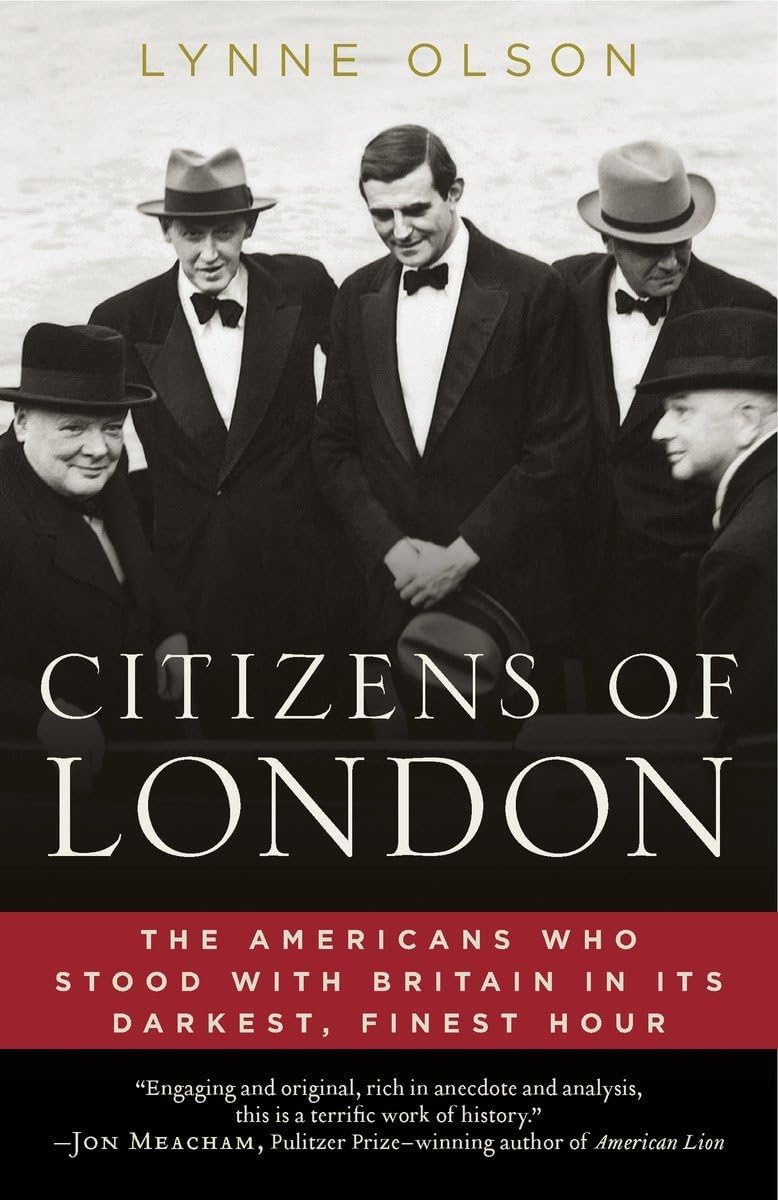
This book was of particular interest to me since my father was a journalist covering World War II from London in the years 1937 - 1940, approximately. He knew Ed Murrow, Eric Severeid, met Winston Churchill, etc, in those perilous times. The book is about the above mentioned politicians/journalists and also about the progress of the war as seen by them from London. The photographic cover of the book plainly delineates some of the main players in the action of the war: Winston Churchill, Harry Hopkins (FDR's assistant), John Winant (the American Ambassador to Great Britain), William Bullitt (Labour politican), and the First Lord of the Admiralty, A. V. Alexander. Winant and Churchill were particularly adamant that America should get into the war, whereas FDR was much against it - America just recovering from the Great Depression could not afford (he thought) to spends lots of money on guns, and shipping men overseas. As we all know, the Japanese by their action against Pearl Harbor, finally got FDR to act, before Great Britain got totally wiped out, and so the War was won by the West. (To sound a little Tolkien-ish about it.) In the book are many charming anecdotes, and tales of the journalists, not to mention the Ambassador, having a lovely time with certain well-bred ladies - as always wartime results in many folks reacting in a very careless way. It is an extremely well-written book, which involves the reader immediately in wartime London and the men and women who lived through it all. Heartily recommended. Linda Sheean
G**D
A must read as to why the world is the way it is today.
An amazing insight into why the world is the way it is today. The full unvarnished truth about what really happened and who was responsible. Truth is always way more outrageous than fiction ever could be. Lynne Olson does a great job of getting to the very personal reasons why things happened the way they did.
Trustpilot
2 months ago
2 months ago