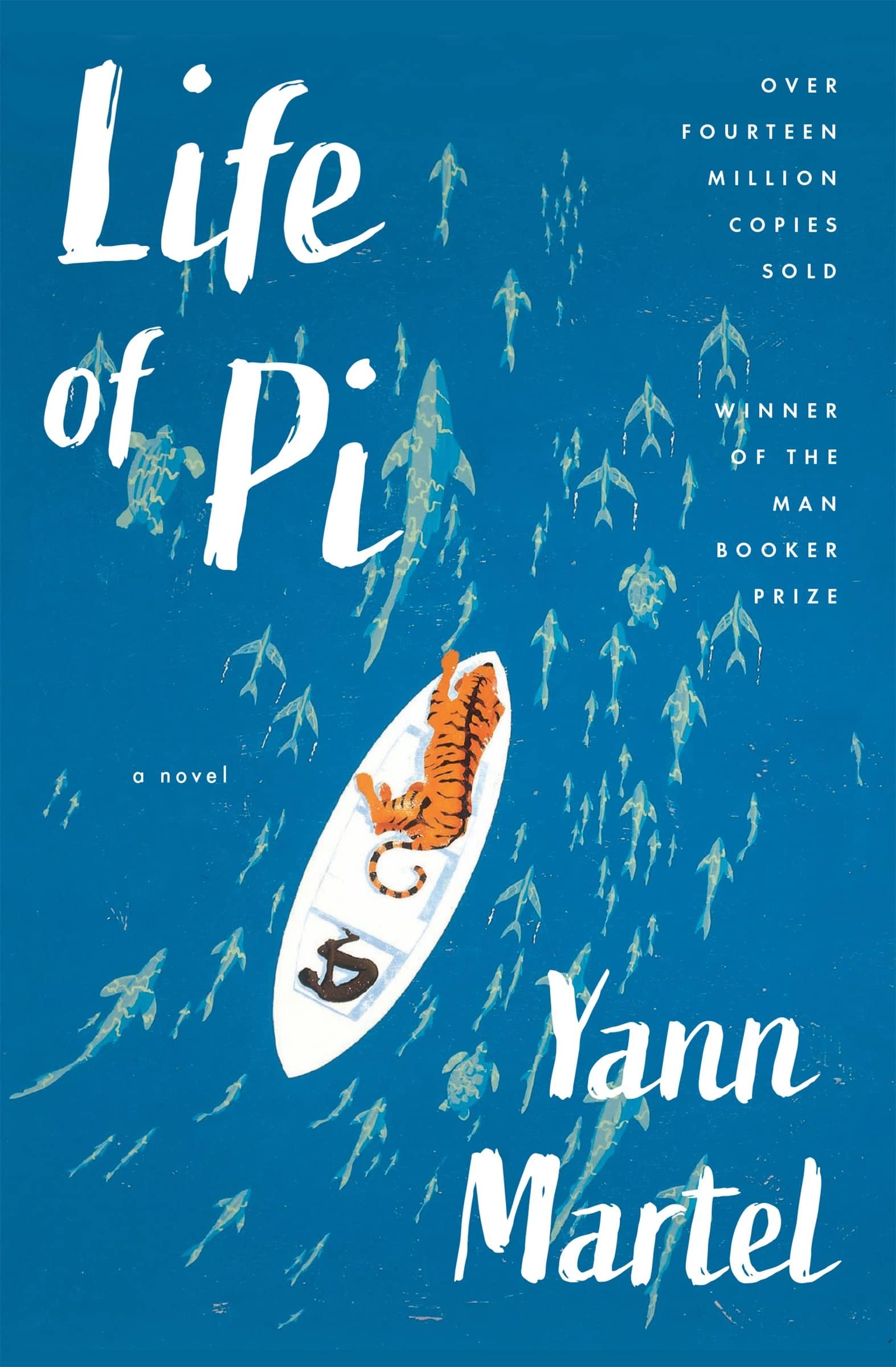
Life of Pi: A Man Booker Prize-Winning Work of Magical Realism
Product ID: 1286190
⛵lifeboat odyssey
🐅Bengal tiger companion
📚277 days survival saga
Buy anything from 5,000+ international stores. One checkout price. No surprise fees. Join 2M+ shoppers on Desertcart.
Desertcart purchases this item on your behalf and handles shipping, customs, and support to Botswana.
🐅 Survive the impossible, believe the unbelievable.
Life of Pi by Yann Martel is a critically acclaimed novel that chronicles the extraordinary survival of Pi Patel, stranded on a lifeboat with a Bengal tiger for 277 days. Blending adventure, spirituality, and philosophical inquiry, this bestseller challenges readers to explore the nature of truth and faith through a masterful narrative structure. With over 22,000 reviews and top rankings in literary fiction, it’s a must-read for those craving depth and intrigue.


| Best Sellers Rank | #1,726 in Books ( See Top 100 in Books ) #21 in Contemporary Literature & Fiction #55 in Psychological Fiction (Books) #153 in Literary Fiction (Books) |
| Customer Reviews | 4.4 out of 5 stars 23,054 Reviews |
M**S
A Triumph On The Surface And Much Deeper
The novel `Life of Pi' was only on my distant radar, until I saw the stunning scenes of this mega-3d movie made by Ang-lee, my brother by another mother. Of course, I wanted to go `book first, movie second', since the other way around just doesn't work as well, so I jumped into the novel to free myself to see the movie. The Life of PI is the story of a young man, a religious studies and zoology major in college, who sees truths and beauty in 3 major religions so chooses to follow all of them. This spiritual world gets hammered and tested when a shipwreck leaves him lost at sea on a lifeboat along with some of the animals his father was transporting to sell to other zoos. The novel was simply tremendous. The writing was both easily digestible and yet filled with deeper implications. Piscine's, or "Pi's" thought patterns were intriguing, including his initial inquisitiveness and near naivety before the shipwreck, to his brain's struggle for survival and the delirium that follows, to his post-rescue riddling of the insurance representatives investigating the cause of the crash. (This is not a spoiler, since the reader knows right up front that Pi survives.) This novel can be read simply for an action, intrigue, and the survival story which rivals any other, but my guess is there are tons of English professors who would love to see their students turn in papers with the following as subjects: ~Symbolism of the Hyena, the Orangutan, the Frenchman, and especially, Richard Parker The Tiger. Fear, nature, the Id or duality of man, childhood demons conquered (you're going to be a goat fed to the tiger, his brother tells him) ~Compare the Tiger in Life of Pi to the volleyball `Wilson' in Castaway. Okay, you may just get some laughs and nothing higher than a B+ if you write this paper. ~Compare and contrast life before and after the boat, compare and contrast life on the boat to life on the island. ~Role of carnivores versus omnivores in the novel. ~Nature of storytelling itself. Both in Pi's early desire to compare and contrast the mythology of major religion, to his story of how he survived the shipwreck, stories are presented as providing meaning and creating larger than life myths which lead to spiritual faith. (Pi laments the lack of more grandiose stories in Christianity). Does belief in a story make it more or less true? When you are trying to tell the truth, is it best to do so in Fiction? Ah, to be in school again and spend hours writing such a paper into the wee hours of the night. Good for me, I can just enjoy and think as deep or shallow as I'd like. Among many others, one thing that has stuck with me is the things Pi had to do to get by. Eating animals as part of survival is described as both barbaric and instinctual, and the degree of Pi's desperate hunger leads to desperate measures. While reading, I made some out loud gasps at some of the ways Pi survived, causing others in the room with me to turn their heads and wonder what was on my kindle. But upon completing the novel and still savoring its taste, I found myself noticing all the food I waste and imagining what I would eat `if I really had to'. Like Upton Sinclair's "The Jungle," Life of Pi maybe aimed for the heart but accidently hit the stomach as well. The odd thing is, many readers will discuss back and forth what was real and what wasn't real in the novel, but I like to believe, as I think the author and Pi himself believe, that it doesn't matter and it misses the point. Truth exists in the eye of the storyteller and the observer, and in the mind of the reader, so if you read about it, saw it in your minds eye, then it happened. This novel fired on all cylinders, and I'm going to be waving it under the noses of readers everywhere. And just like Tom Hanks who missed Wilson, and Pi who misses his tiger, I miss reading this novel each night. At least I still have the movie. Mark Matthews, Author of Stray and The Jade Rabbit
K**S
Using stories to find meaning * Possible Spoilers *
Warning: This review may contain some spoilers Why do we choose to tell the stories that we tell in the way that we tell them? Is it to portray unembellished reality or do we chose our narrative in service to a deeper purpose? In the novel Life of Pi, Yann Martel suggests that stories are how we find meaning in the universe; they are a path to God. Martel's characters tell stories that provide comfort, explain hardship, and provide inspiration without being literally factual. The author takes pains to remind the reader that the book itself is a work of fiction and that the literal representation of the truth is not his priority. In fact, Martel seems to say that sometimes we must abandon literal truth if we want to find meaning in the universe. If we fail to look beyond the literal truth in search of something deeper, we will "lack imagination and miss the better story"--we may fail to find God (Martel, 2007, p. 64). Piscine Molitor Patel, known as Pi, is the titular character of the novel. The book's central conflict is Pi's struggle to survive while adrift at sea in a lifeboat after his ship sinks. He must endure against elemental forces, lack of food and fresh water, and stave off despair. However, on top of these very serious challenges, he must also deal with the fact that he is not alone in the life boat. For most of his ordeal, his only companion is a Bengal tiger named Richard Parker: a wild and untamed creature that could easily kill him at any time. However, this is not a simple survival story where the tension comes from wondering if the main character will manage to triumph over adversity. Even before we know a single detail of his ordeal, Martel assures us that Pi is alive and well, living an almost ordinary life. At the same time, he assures us that this is "a story to make you believe in God" (Martel, 2007, Author's Note). Much of the tension of the book comes in discovering what the author means by this. On the surface, this is a survival story. However, this is not really a book about Pi's ordeal at sea; it is about the telling of the story of Pi's ordeal at sea. In the course of the narrative, there are at least five different times that one character tells the story to another. We are only privy to the details of two of these exchanges; the others occur "off stage." However, after each one, Martel shows us the impact hearing the tale has on the listeners. We get the sense that nobody is truly the same after hearing it. This is true even though the two versions of the story we see are mutually contradictory. By this, Martel demonstrates that it is not necessarily the literal truth of a tale that makes it meaningful. There is some other aspect of the story that makes it meaningful. In the Author's Note, Martel calls fiction "the selective transforming of reality" and says that writers create it "for the sake of greater truth" (Martel, 2007, Author's Note). This note is where the narrative actually starts; it is part of the fiction Martel has created, not something that lives apart from the rest of the book. The character of the author appears throughout the book in a series of interludes within Pi's narrative. Martel uses these recollections to describe the man Pi has become and how the events of the story have changed him. The author also uses them to heighten the mystery about what exactly transpired in the lifeboat. He makes numerous references to events that have not yet been shared with the reader, foreshadowing the action to come. Martel devotes most of the book to telling Pi's preferred account of his ordeal. This is a story that focuses on both the practical day-to-day details of his survival and his internal struggle to retain his faith in a higher power. The account is striking in both its realism and its utter implausibility. Even if we ignore the improbability of being able to survive on a lifeboat with an untamed Bengal tiger for 277 days, there are many other aspects of Pi's story that are hard to believe. We know this because Martel takes pains to have other characters, such as the shipping agents who hear the tale, point out the implausibility of these aspects. Details such as encountering another lifeboat at random in the Pacific midway through the journey, finding an almost magical floating island, and just the act of being able to survive in a lifeboat for 277 days are all highlighted as being hard to believe. However, this is not the only account of the events that Pi offers. He tells an alternative version of the events that is just as brutal and unforgiving as the other, but far more plausible. In this story, many more things make sense. Pi's actions are selfish, even if excusable. His thoughts are about survival, revenge, and satisfying his hunger, not his relationship with God. This version has only ugliness; it offers no meaning. Pi tells the shipping agents both of these stories and offers them a choice; the author does the same for the reader. Pi seems to prefer the version of the story where he finds meaning because that is something he craves. Earlier in his narrative, he describes how his search for meaning caused him to become a Christian, a Muslim, and a Hindu, all at the same time. Each of these religions tells stories that explain the universe; they provide meaning and comfort. Pi embraces all of them. He feels no need or obligation to choose between these mutually exclusive stories. Why should he choose? The author told us in the Author's Note that stories are selective transformations of reality for the sake of greater truth. Pi craves this truth; he wants to know God and not restrict himself to "dry, yeastless factuality" (Martel, 2007, p. 64). For the most part, both versions of Pi's narrative have the same elements; each of the fanciful aspects of the first narrative has a corresponding aspect in the second narrative that is tragically believable. However, there is a key part of the first narrative that does not appear in the second one: the floating island. This is the least plausible portion of Pi's first narrative. The island is an idyllic place (at least at first) with almost magical properties. It is wholly absent from the second narrative. This is a mystery within a mystery; the shipping company representatives he tells the story to give up trying to understand it. We are left to wonder if it points to a gap in Pi's second story, a piece that explains how a man could survive that long at sea. On the other hand, maybe it does not appear in the second story because it was literally true and needed no amendment. We are left to wonder. Martel is careful to leave the door open for both interpretations of the story. For instance, one of the shipping representatives calls the island a botanical impossibility (Martel, 2007, p. 294). However, the representatives had also just assured Pi that the floating island of bananas that appeared earlier in the story was similarly impossible, an assertion that Martel shows proven wrong (Martel, 2007, p. 293). In this way, Martel hints that if the representatives were mistaken about one floating island, they might be mistaken about another. If one thing that is hard to believe is possible, perhaps another incredible thing also can be so. Even when we are convinced we know what happened, Martel reminds us that we should have doubt. The author tells us how he has read the diary that Pi kept during his ordeal. In it, we are shown Pi questioning his relationship with God. This is the Pi of the first story, not the survival obsessed pragmatist of the second one. There is always reason to doubt. Why does Martel tell this story in the way that he does? Why is this not a simple linear narrative of a boy trapped on a lifeboat with a tiger? Martel tells the tale this way because he wants the reader to face the same choices that his characters face. He uses a complex structure of narratives within narratives in order to create ambiguity. The reader is left to decide what really happened. Do we choose the version of events with meaning, or the one with plausibility? Which one do we prefer? Is the "more plausible story" truly plausible? Martel refuses to give us definitive answers to these questions. Martel uses the plot and structure of the book to show that it does not matter if either is true. It does not matter if the author invented this story or if, as he says, it was told to him. What matters is the meaning we choose to give the story as readers. Work Cited Martel, Yann (2007). Life of Pi (Kindle Edition). New York: Houghton Mifflin Harcourt. (Original work published 2001)
P**T
the Super Cool Facebook Readers Group review
Life of Pi Yann Martel Life of Pi is the epitome of discussion books, one that stirs and inspires debate and conversation many days, weeks and months after the book has been read. Life of Pi is a book that can be read over and over and elicit different results and reader reactions each time it is read. A complex book about religion and survival that grants the reader his/her own interpretation of the story without allowing anyone to refute it. Life of Pi is a true literary master piece that can be enjoyed by many different readers. Life of Pi is about an Indian born boy by the name of Piscine Molitor Patel or Pi as he chose to be called, his religious exploration and his survival at sea for 227 days. The story begins like most religious fiction, glorifying one religion over the rest but quickly does and about face and introduces two more religions and atheism into the lineup. Pi a lover of God saw no reason why a person should not be allowed to practice freely any and all religious dogmas as he saw fit, so he practiced Hinduism, Islam and Christianity. Religion was just a path to God in Pi's eyes and the more paths he established the more ways he was able to bask in the Almighty's glory and grace. The religious convictions he establishes as a child in India would help him survive if only spiritually while drifting in a life boat as a teenager on the open waters of the Pacific Ocean. The Pacific Ocean is where most of the story about Pi takes place. The landscape of continually rolling waves comes alive through Yann Martel's use of words. Yann has an amazing vocabulary and can elicit beautiful and shocking imagery with it; he turns the dull ocean into something extraordinary. Extraordinary is not hard to come by when Pi is forced to share his life boat with a 450 pound Bengal tiger by the name of Richard Parker. Richard Parker and Pi become ship mates after the cargo ship they were on sinks. Richard Parker and Pi share a unique relationship and adventure as they troll the mighty waters of the Pacific. The harmony between the tiger and the boy is essential if they both are to survive. Survive they both do but not before they suffer the effects of starvation, dehydration and bad weather many times over. The story ends with an interview between Pi and two Japanese investigators for the Ministry of Transport in a Mexican hospital. The investigators are interested in what caused the cargo ship to sink and hoped that Pi could shed some light on it for them. Pi cannot shed light on the sinking of the ship and you would think that would be the end of the story but it is only the beginning. The conclusion to this story about survival at sea with a tiger is what makes this story a great discussion book. Not to give away any secrets this review will only surmise to say that the end offers a twist that will have you rethink the entire story. Life of Pi is a beautifully written story by Yann Martel. The characters and story are well developed and mature as the story progresses. The imagery is so rich that it causes the reader to delight in the good and suffer during the bad. Life of Pi is a story about survival, religious convictions and a Bengal tiger named Richard Parker that everyone will enjoy in reading and discussing over and over again.
F**M
Beautiful Story of Faith and Survival
Pi Patel, unfortunately named after a pool, is a peculiarly devout boy growing up in India. His family consider themselves to be "Modern Indians" preferring to put their faith in Business than in God; his practises are unorthodox to his preachers and perplexing to his family. The shifting of politics in India, force Pi's father to make the decision to sell off the zoo he owned and operated, and emigrate to Canada, beginning Pi's miraculous journey across the Pacific. After the cargo ship, transporting Pi's family and animals goes down, Pis is left stranded on a lifeboat with his belief in a higher power and a dangerous Bengal tiger... I don't consider myself agnostic or atheist, but I'm not traditionally religious... My parents aren't religious, they didn't take me to church or instruct me on what we believed; I was left to make my own conclusions about the world as I saw fit. I grew up believing in the power of books above all else; books that were meant to teach and books that were meant to entertain, not that either were always mutually exclusive. I worshipped in libraries and bookstores, in school cafeterias and in my own backyard; as someone who's got her own ideas about God, I loved the message this book sent out. <i>"I just want to love God,"</i> Pi responds, when confronted by a priest, a pandit, and an imam, who tell him there is no such thing as a practising Hindu-Christian-Muslim, and he must choose only one. How can you not love Pi just a little for defying religious conventions that have sparked so many wars? Over and over Pi's faith is tested by another recurring theme: The primal need to survive. Pi's been a vegetarian his whole life and now, lost at sea with an animal that is willing to kill to survive and a limited stash of food and water, Pi's going to have to make some tough decisions. In order to keep the tiger from viewing Pi as a potential meal, he has to establish himself as an Alpha and a Provider. That means being more aggressive than the 450-lb cat that threatens his life and ultimately, learning to kill. I love the metaphors Algae Island offers; Algae Island is a floating island of algae that grows trees to harvest sunlight, has plentiful fresh water pools that poison saltwater fish, and is overpopulated by mindless meerkats... Here on the island, Pi and Richard Parker find everything they need, it's a literal paradise. There's edible greens for Pi and meat for Richard Parker. There's plenty of freshwater and protection from the harsh elements. I can't help seeing a metaphorical Eden at this point in the story. The meerkats -- Pi notes they originate from Africa, while I note Africa as the known birthplace of humanity -- are content living in their mysterious floating garden. Its only when Pi's curiosity becomes too much to bear and he plucks a strange fruit from a strange tree, that he realizes he can't stay on the island forever. He and Richard Parker must leave and never return. And of course, now we hit the one flaw in the book. The abrupt transition between being lost at sea and making landfall in Mexico. They're at sea--and then they're not. I suppose there is some kind of mirror there, something to be said about the abrupt goodbye to the ocean and the abrupt disappearance of Richard Parker... Pi will eventually be questioned about the loss of the cargo ship and his journey. The officials think his story is a tragic lie, invented to cover up trauma from the actual tragedy. In response Pi tells them another story, more brutal than the first and asks them to sort out for themselves which one they prefer, which one is truth. I won't lie here; the very last paragraph of the book made me cry a little. Ps. It should be noted that the Author's Note is part of the storyline...Just incase you want to read the book and you're a AN-Skipper.
N**.
Read with a group of fellow students/friends - Would read again and again!
Yann Martel’s Life of Pi raises a question that no other novel has ever done before. In proper paradox, the author catalogs the tale that Pi tells of his voyage and one in which one in which replaces the barbaric animals with human beings, seemingly questioning both the Japanese officials and reader’s faith one token. The Japanese authorities who interrogate Pi refuse to believe his story and press him to tell them "the truth." After hours of coercion, Pi tells a second story, a story much less fantastical, much more conventional—but is it more true? The son of a zookeeper, Piscine “Pi” Molitor Patel has an encyclopedic knowledge of animal behavior and a fervent love of stories. When Pi is sixteen, his family emigrates from India to North America aboard a Japanese cargo ship, along with their zoo animals bound for new homes. The ship sinks. Pi finds himself alone in a lifeboat, his only companions a hyena, an orangutan, a wounded zebra, and Richard Parker, a 450-pound Bengal tiger. Soon the tiger has dispatched all but Pi, whose fear, knowledge, and cunning allow him to coexist with Richard Parker for 227 days while lost at sea. When they finally reach the coast of Mexico, Richard Parker flees to the jungle, never to be seen again. Much in the story is left up to the reader’s imagination as it leaves out key details that prove to be crucial to the story such as the sinking of the Tsimtsum and the disappearance of Richard Parker. In part one of the book, Yann Martel sets up the theme of religion by establishing Pi’s poly-religious worshipping preferences: Christianity, Islam, and Hinduism. More so, Martel’s introduction and analysis of the zoo give the reader thoughtful insight into his purpose for the book. Martel hopes to inspire readers’ thoughts by using animals to symbolize how similar people are in fact to other species. In part two of the book, the reader is unaware of the significance of the novel (which could be perceived as ineffective by some at this point), and what Yann Martel is trying to bring to his or her attention. At this point in the novel, Martel relies on his extremely gifted storytelling abilities, giving the reader the impression that Life of Pi is just another entertaining modern survival novel. However, the author makes sure to give subliminal messages throughout the novel, almost all of which carry a heavier significance by part three of the book. There are times when Martel pushes the didactic agenda of his story too hard. One episode involving a bizarre ''Gandhian'' island of carnivorous seaweed -- populated by an enormous herd of South African meerkats -- struck as a little too baldly allegorical, however magical in its imagery. Despite this Martel is able to keep his feet on the ground by focusing on the physical and logistical details of his hero's predicament. Moreover, in the book's final chapters Martel gives Life of Pi an intriguing twist. After the lifeboat comes safely to shore in Mexico (and Richard Parker disappears without ceremony into the jungle), Pi finds that his wild narrative is not believed by the officials sent to debrief him. And he knows exactly why: ''You want a story that won't surprise you. That will confirm what you already know. That won't make you see higher or further or differently. Urged to provide a more credible explanation for his survival, Pi placates the officials with a story that contains just the kind of ''dry, yeastless factuality'' they're looking for. But is this more straightforward (and tigerless) version of events actually closer to the deeper truth of his adventure? It's a testimony to Martel's achievement that few readers will be tempted to think so. Whether the first or second story is accurate is left up to the reader to decipher. Perhaps the best indication of Life of Pi as a contemporary Postmodern novel is its theological destitution: instead of being interested in the theological basis of Pi’s soul, it is really interested only in the theological basis of storytelling. The former is or could be a day to day, lived reality; the latter is only a piquant but now familiar contemporary abstraction. Yann Martel’s prose leads the reader to believe Pi’s abstract story as told with conviction and establishes a bridge between religion and the moral of the story being hope: without hope the situation seems helpless and barbaric but with hope the situation is romanticized and tells the tale of love and admiration. The novel leaves the reader desiring more of the story and will leave him with a better understanding of animals, the barbarity of the human race and will leave much to ponder about the story of a young man and his journey with a Bengal Tiger.
J**N
"On the fence" about this one.
(Spoilers.) I first read this book when it was originally published. After reading it again recently, I remembered liking it a lot more back then than I did this time around--perhaps because my critical thinking skills have improved since then. The book has three sections: 1) It sets the premise in two ways simultaneously: a) very detailed descriptions of zoo animals and their ability to adapt to situations and humans and b) introductions to several religions and one boy's love for them all. Suffice it to say, there's a lot of foreshadowing all throughout this section. This part takes some persistence to get through because it can be really dry; fortunately, there are some compelling parts thrown in. 2) Pi's experiences on the boat with the animals, survival, adaptation, suffering--basically what you'd expect to read in a book about survival at sea. It all ties back to what we learned in the first section about animals and their adabtability. 3) His rescue and interrogation about what happened to the Tsimtsum and everyone else aboard it. There is also significant focus on the truth of his story regarding the animals and a curious retelling of the story involving no animals at all. Overall, it's a very simple story that is somehow made into 400 pages. :) Even during the dry parts in the beginning, I kept reading and never had a desire to stop. I wanted to know what happened and Pi is a likable character. But, there were several things that didn't sit right with me: - Disproving one's own theories. Martel states a less-than-positive view of agnostics, in that they are "on the fence" and why would you not just pick one side or the other? However, irony is introduced when Pi is unable to pick a religion he likes best, so he follows three of them. So... indecision about whether or not a higher power exists is disgraceful, but following several religions because you can't decide between them is to be lauded? - Unexplained chapters from the future. I did not understand the chapters that were in italics, which were apparently someone visiting Pi's home in the future and writing his story down (thus supposedly creating the book we're reading now). These chapters never seemed to lead anywhere for me, they mysteriously stop in the middle of the book, and they added no value. They only served as a confusing spoiler to show that Pi survived his ordeal. They felt thrown in and hurt the continuity, like the book had to be 100 chapters exactly and so fluff was needed. - Rambling on and on and on... I skipped a lot of large sections that were paragraph upon paragraph of foods he wanted to eat, descriptions of the surroundings, and other topics. I get it already! Sheesh. - What was the point? I have no idea what Martel meant with the ending of the book. I felt like so much was set up with the relationship between the first and second parts of the book, but then it all was forgotten in the third section where things should have been tied neatly together, like Martel was as lost in his own book as Pi was at sea. Is the point that we all want to believe in something fantastical, no matter how improbable, because that's better than being faithless, so this book is meant to be a metaphor for why people turn to religion? Wouldn't this negate the purpose of the book entirely because, rather than demonstrating the importance of constant, fervent faith, it would be like comparing religion to escapism and fantasy, showing it to be a coping mechanism people use because they can't handle life as it is and they don't want to take responsiblity for their own fate? (Which is basically how atheists feel...) Or maybe that IS the point and Martel is actually disproving of religion when all along I thought he was advocating it? I don't know! - I cannot reconcile Pi as the tiger. -- Does that mean that the tiger showed how Pi was at odds with himself at times? -- It is supposed to represent Pi's inner strength? -- Does it mean Pi developed a dual-personality to cope with the situation? -- Does this "prove" that, in fact, there were no animals aboard at all and Pi made them all up as a form of escapism instead of choosing to believe the truth of what was happening to him (which, as I stated previously, would negate the point of the whole book)? -- Maybe Pi was just insane? -- Maybe it doesn't matter if the animals existed or what version is true because in the end Pi was neither helped or hindered by religion and all that mattered was that he survived, not how he coped? (Which, again, wouldn't seem to serve the purpose of the book.) All that said, this book is at least worth reading, if nothing else to form your own opinion on it and find your own meaning in it. Maybe you will be less confused than I was. :) Plus, I actually found the version with the people more compelling than the version with the animals, so that alone was worth the read.
R**O
Eeny, meeny, miny, moe, catch a tiger by the toe...
Eeny, meeny, miny, moe, catch a tiger by the toe. If he hollers, let him go, Eeny, meeny, miny, moe. For some reason that children's rhyme popped into my mind as I started to read this tale of survival. It involves a 16 year old Indian boy, and a 3 year old, 450 pound Bengal Tiger marooned together on a lifeboat for 227 days in the Pacific Ocean. Wow, what a tale spun by the Man Booker Prize winner, Yann Martel. Oh, I forgot to mention that initially there was also a zebra, a rat, a hyena, and a orangutan on board. You can imagine how long they lasted with a furious tiger aboard. Did I like this novel? Yes, but I'm not sure it was worthy of the "Booker" award. It has the strength of an unusual story, but lacks the strong finish to knock the reader out. I did like Martel's easy to understand prose, and I also enjoyed the font changes that let the reader know who was narrating the story. It's a difficult novel to rate because of the long and sometimes tedious middle, and then the seemingly abrupt ending. Yet it was so entertaining. Do you see my dilemma? I must recommend this novel by virtue of it's original and exhilarating story, even though some say that it was similar to Moacyr Scliar's 'Max and the Cats'. The first part of the story introduces the reader to our protagonist, Piscine (self changed to Pi, because of people mispronouncing his name as `pissing') Molitor Patel. He lives with his father, mother, and brother Ravi in Pondicherry, India. The family owns a prominent zoo during the turbulent reign of Prime Minister Indira Gandhi in the mid 1970s. Pi is going through a confused time in his life were he is unsure if he is a Hindu, a Catholic, or a Muslim. This is one part of the book that I didn't think was relevant to the story. Anyway, Pi's father has had enough of India's politics and decides to sell his wild animals to various zoo's in America and elsewhere. He boards his family and animals on the Japanese cargo ship, Tsimtsum with the ultimate destination of Canada, and a fresh start in life. But guess what? The ship sinks several days out of port, resulting in the loss of Pi's family and everybody else, except for Pi and a few animals treading water. As the ship sinks, Pi has been tossed into a lifeboat by crew members. He sees the tiger ( Richard Parker ) struggling in the water. Pi throws a roped lifebuoy to the tiger and starts to haul him in, and then realizes that he is dragging a wild tiger to his boat! Pi says " Let go of that lifebuoy, Richard Parker! Let go, I said. I don't want you here, do you understand? Go somewhere else. Leave me alone. Get lost. Drown! Drown!" Too late, the tiger pulls himself aboard. You might wonder how a tiger got the name Richard Parker. Well, when the tiger was young, he was captured by a hunter named Richard Parker. The hunter saw the tiger drinking a lot of water, so he named him " Thirsty ". However when they went to the ticket booth for the train ride to the zoo, confusion ran amok, and the names on the tickets got reversed, and the hunter became Thirsty, and the tiger became Richard Parker. At the zoo, Pi's father thought it was amusing and kept the unusual name for his tiger. Most of the remaining novel is about survival at sea, or man versus beast for seven months on a 26' by 8' lifeboat. Who wins? Can Pi train the tiger on the boat? Will the tiger try to eat Pi? Can Pi catch enough food to keep Richard Parker happy? These are a few of the questions that will be answered, as you read this daring fantasy tale. This novel is well worth the effort, I suggest you add it to your books-to-read list.
Z**S
Life of Pi - a review of the book ONLY for people who have read it
This is a thrilling adventure story that has made me laugh and weep. In this review I plan to talk about the wonderful, exciting story in its entirety. It's better not to read it if you want to maintain a sense of surprise which Yann Martel, amazingly, continues to do in his story. So please, stop now if you have not read this book. It's that sense of surprise that kept me reading, dragging me through the story as if I were tied to a truck rolling through a busy street. I couldn't put the book down. I was pulled through it by my curiosity. Read it then come back and write about it. A boy and a tiger on a boat. It sounds like it belongs under the magical realism section, with Salman Rushdie. But its not. The story is told by a narrator acquainted with the mathematics of animal-human interaction. But to confine this story to one within the limits of zoology would be ludicrous. Pi is a student of religion and animals. Religion perhaps is something that differentiates humans from animals and that question of what makes us humans unique is a recurring theme in the story. For Pi, the love of God is mankind's unique and greatest joy. It's not a God that belongs to a people or a culture, but a universal God, the Creator of a world that Pi loves. "A God", as Pi says in a memorable line, "whose presence is reward enough". If love of God is unique to human beings, then so is intelligence. And it is intelligence that Pi uses to survive the long journey, on a small boat, with a tiger. With constant awareness of the tiger's state of mind, and the resources available to him, Pi does survive, and this seemingly miraculous survival is what makes up the bulk of this story's 100 chapters. Pi survives to tell the tale. Had the story finished with his final adventure, another battle against the inevitable hunger and danger of his travel companion we would have a story both miraculous and amazingly - acceptable. But the story continues. After his rescue Pi is interviewed and after great stress gives a second description of his survival. This description is gruesome, horrific, and since it differs to the story we have just finished reading, raises very challenging questions. Firstly and most importantly, which version is the true one? Could such a horrific and gruesome story have been made up? But on the other hand, can we really consider dismissing the original story as a mere metaphor for the second "true" story? What of the spectacular details? And what of those parts in the first story which don't seem to map to the second version so easily? Is the first story just a metaphor? If it is, then this is ultimately a book about the human need for myth as a means for living with impossible truths. If it is not, and the first story is the true one, then this second story is just a bone thrown to a dog, a "rational" version of events thrown to a "rational" interviewer, a fool for whom "reason is gold". Which is the true answer? Do we accept the first or the second version? Ultimately, Yann Martel asks us to choose: Is it a believable fantasy, or is it a necessary metaphor? How we choose is maybe related in no small measure by our own relationship with reason and rationality. Do we rely on them entirely for our survival, or might we allow for something else, some unfathomable good "beyond the realm of thought and language"?
X**X
An amazing book, must read!
This book is one of my favourite stories. Martel blends reality and fantasy so well that I had to keep examining the book jacket to see if it said "based on a true story" anywhere.
M**G
Orijinal basım ve Çok temiz geldi
Tertemiz ve elime hızlı ulaştı teşekkürler
S**P
all good
delivered as promised
N**A
Amazing!
One of the best books I’ve ever read!
V**R
Interesting book.
Recommend fir those who seek unexpected adventure!
Trustpilot
1 month ago
1 month ago