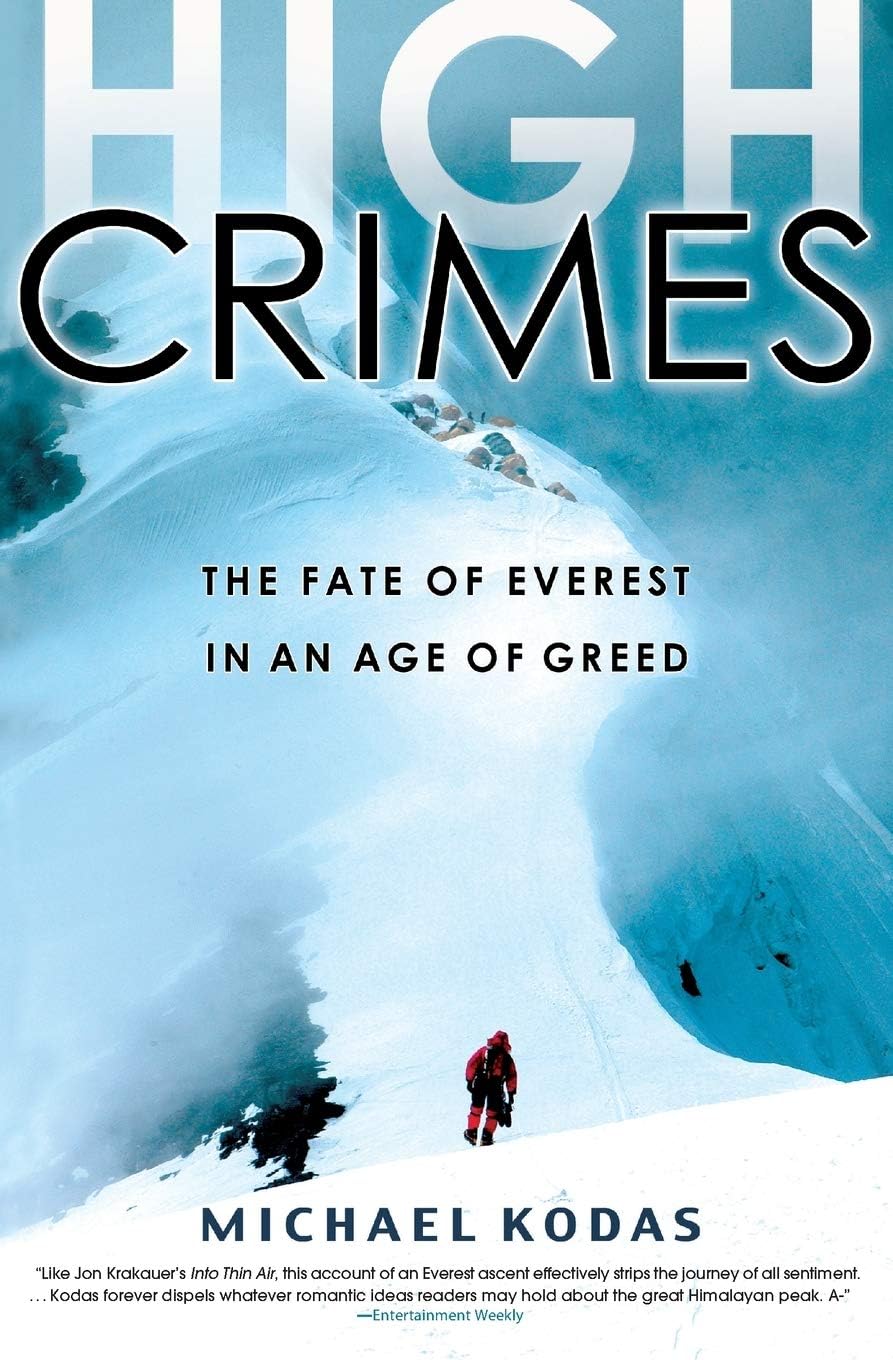
High Crimes: The Fate of Everest in an Age of Greed
Product ID: 12475625
Buy anything from 5,000+ international stores. One checkout price. No surprise fees. Join 2M+ shoppers on Desertcart.
Desertcart purchases this item on your behalf and handles shipping, customs, and support to Botswana.
High Crimes is journalist Michael Kodas's gripping account of life on top of the world—where man is every bit as deadly as Mother Nature. "Well written, and as deftly plotted as the finest mystery novel, Kodas brings to life a disturbing picture of society at high altitude." ― Austin Chronicle In the years following the publication of Into Thin Air , much has changed on Mount Everest. Among all the books documenting the glorious adventures in mountains around the world, none details how the recent infusion of wealthy climbers is drawing crime to the highest place on the planet. The change is caused both by a tremendous boom in traffic, and a new class of parasitic and predatory adventurer. It's likely that Jon Krakauer would not recognize the camps that he visited on Mount Everest almost a decade ago. This book takes readers on a harrowing tour of the criminal underworld on the slopes of the world's most majestic mountain. High Crimes describes two major expeditions: the tragic story of Nils Antezana, a climber who died on Everest after he was abandoned by his guide; as well as the author's own story of his participation in the Connecticut Everest Expedition, guided by George Dijmarescu and his wife and climbing partner, Lhakpa Sherpa. Dijmarescu, who at first seemed well-intentioned and charming, turned increasingly hostile to his own wife, as well as to the author and the other women on the team. By the end of the expedition, the three women could not travel unaccompanied in base camp due to the threat of violence. Those that tried to stand against the violence and theft found that the worst of the intimidation had followed them home to Connecticut. Beatings, thefts, drugs, prostitution, coercion, threats, and abandonment on the highest slopes of Everest and other mountains have become the rule rather than the exception. Kodas describes many such experiences, and explores the larger issues these stories raise with thriller-like intensity. Review: High altitude attitude - After reading this book, it's clear the armchair adventurers who have always dreamed of Everest should perhaps concentrate on more pedestrian, less-life-threatening pursuits - say, helicopter skiing, or extreme whitewater rafting; even high-altitude hang-gliding. Mountain climbing would appear, in this day and age, to be fit only for canny professionals. Tyros need not apply, on pain, literally, of death. I heard the author of this book, Michael Kodas, being interviewed on National Public Radio, a lightning rod for me in deciding on literary works; if NPR thinks it's worthy of note, then I usually will read whatever book is being discussed. It helped that the author seemed well-informed, at pains to be fair to all concerned, even restrained in his answers; it intrigued me all the more. I can't recall the last time I bought a book, hardbound, right at publication. This was a worthy read. I will never understand what it is that drives people to WANT to crawl up the face of a mountain, literally hanging in space, aware that they are courting frostbite, storms, failure, and death, from the capricious mountain they yearn to conquer. As it turns out, the mountain - Everest - is almost the least of their worries. Michael Kodas, a journalist for the Hartford Courant, and several other Connecticut people collaborate with a successful climber of Everest to make an attempt at the summit of the one mountain every mountaineer hungers to put on their resume. None of them, apparently, are rank amateurs; the nominal leaders of the party have achieved the summit several times already. But what they are all totally unaware of is the level of humanity to which the base camps has stooped in the past twenty years. The book chronicles two parallel climbs, on opposite sides of the mountain; Mr Kodas's party, and another party fully funded by a wealthy transplanted Bolivian doctor from the Washington, DC area. There is pure tragedy in the doctor's party; he has hired a guide whose credentials he trusts, who turns out to be the lowest sort of glory hound. Mr Kodas's party, not even starting out with all members on a level footing, descends into a bickering, acrimonious mess, with saboutage, missing equipment, and cruelty thrown into the mix. Apparently it has devolved into an every-man-for-himself mindset on Everest over the years. The climbers - who, just because they can afford to climb, doesn't mean they should - are the chief source of revenue for the Sherpas who are native to the area, and those poor people can perhaps be somewhat forgiven in taking what advantage they are offered by the advent of a lot of ill-prepared, difficult-to-deal-with Westerners, whose whole goal is summit. The stories of them routinely bypassing dying climbers who might, with intervention, be saved, chilled me to the bone. Theft of gear and saboutage of equipment are rampant. The most chilling story in the book was of a climber, having achieved the summit, rappelling down to one of the camps and looking behind him just in time to see that the rappel rope ends just below where he is, over a fearsome void; the rest, along with the anchors, has been stolen. His perilous primitive climb down the rest of the route gave me goose pimples. Most of the book seesaws between the tale of the doctor, left to die by an unscrupulous guide, and the doctor's daughter's subsequent and dogged efforts to discredit the guide out of ever doing the same thing to someone else; and Mr Kodas's trials with the fractious and foreboding leader of his expedition. I really think I would have left far sooner than Mr Kodas; the leader sounds unhinged at best, and at worst downright criminal, threatening the lives of those in disagreement with him, not to mention throwing in some domestic abuse, as he assaults his wife in front of everybody. The Base Camps on Everest would appear to be very unpleasant places, no better than the Wild West of the 1880s; and Mr Kodas does a good job of demystifying Kathmandu as well, a place I had long held in my mind as full of peace, harmony, and followers of the Dalai Lama, and which instead appears to be little better than a grimy little border town on the frontier. I do not read books very fast, but I zipped through this one; someone else commented that they had a hard time remembering who was who, but if you keep in mind what storyline you are following - aside from the very interesting side stories, of which there are many - it isn't hard; and this is a heckuva good read. Review: Thought Provoking & Sad - I may be on the fringe of popular opinion here but I find it difficult to feel sorry for Dr. Antezana and his fate. I think his guide Gustavo has serious psychological issues and needs to be be dealt with legally, but seriously......Dr. Antezana made some very poor choices. He was suspicious, distrustful of Gustavo and unhappy with his level of support but ignored all of his intuition and climbed anyway. As an athlete (but not an extreme one) I understand how you can be driven toward an objective and blind to ominous feelings and in that regard, I'm empathetic. Nonetheless, the victim must accept the responsibility for being foolish. Climbing Everest is not a walk in the park! I feel badly for the people who felt guilty because they didn't say something to encourage Dr. Antezana not to climb; thinking they could have avoided his fate. To me, no one could have avoided his fate but himself. He was not an 18 year old giving into peer pressure, he was a 69 year old, intelligent, successful man who made a deadly choice to climb Everest. All the other examples of poor behavior and bad choices in this book just means there were more foolish people with money and time on their hands who like to participate in extreme sports (snowboarding down Everest, really?). And for each of them, there was someone to sell them the experience based on what they could afford. What is truly sad is that this pathetic side of humankind overshadows the effort serious climbers take to prepare and train for this phenomenal endeavor; the climbers who give up on the dream to help another in distress and/or risk their life for another. This author gave us the darkside. This book is not a positive story of human triumph over adversity; it's a painful and sad story of some ugly human ambition and risk taking, which will continue so long as people push the limits of physical abilities to try to tempt fate. Some folks will "jump on the bandwagon" of the latest extreme craze and end up dead because they will not be prepared and will foolishly put their trust in the untrustworthy just so they can say they did it! Good book, sad book.
| Best Sellers Rank | #268,902 in Books ( See Top 100 in Books ) #13 in Mountain Ecology #65 in Mountain Climbing #407 in Traveler & Explorer Biographies |
| Customer Reviews | 4.1 out of 5 stars 621 Reviews |
F**)
High altitude attitude
After reading this book, it's clear the armchair adventurers who have always dreamed of Everest should perhaps concentrate on more pedestrian, less-life-threatening pursuits - say, helicopter skiing, or extreme whitewater rafting; even high-altitude hang-gliding. Mountain climbing would appear, in this day and age, to be fit only for canny professionals. Tyros need not apply, on pain, literally, of death. I heard the author of this book, Michael Kodas, being interviewed on National Public Radio, a lightning rod for me in deciding on literary works; if NPR thinks it's worthy of note, then I usually will read whatever book is being discussed. It helped that the author seemed well-informed, at pains to be fair to all concerned, even restrained in his answers; it intrigued me all the more. I can't recall the last time I bought a book, hardbound, right at publication. This was a worthy read. I will never understand what it is that drives people to WANT to crawl up the face of a mountain, literally hanging in space, aware that they are courting frostbite, storms, failure, and death, from the capricious mountain they yearn to conquer. As it turns out, the mountain - Everest - is almost the least of their worries. Michael Kodas, a journalist for the Hartford Courant, and several other Connecticut people collaborate with a successful climber of Everest to make an attempt at the summit of the one mountain every mountaineer hungers to put on their resume. None of them, apparently, are rank amateurs; the nominal leaders of the party have achieved the summit several times already. But what they are all totally unaware of is the level of humanity to which the base camps has stooped in the past twenty years. The book chronicles two parallel climbs, on opposite sides of the mountain; Mr Kodas's party, and another party fully funded by a wealthy transplanted Bolivian doctor from the Washington, DC area. There is pure tragedy in the doctor's party; he has hired a guide whose credentials he trusts, who turns out to be the lowest sort of glory hound. Mr Kodas's party, not even starting out with all members on a level footing, descends into a bickering, acrimonious mess, with saboutage, missing equipment, and cruelty thrown into the mix. Apparently it has devolved into an every-man-for-himself mindset on Everest over the years. The climbers - who, just because they can afford to climb, doesn't mean they should - are the chief source of revenue for the Sherpas who are native to the area, and those poor people can perhaps be somewhat forgiven in taking what advantage they are offered by the advent of a lot of ill-prepared, difficult-to-deal-with Westerners, whose whole goal is summit. The stories of them routinely bypassing dying climbers who might, with intervention, be saved, chilled me to the bone. Theft of gear and saboutage of equipment are rampant. The most chilling story in the book was of a climber, having achieved the summit, rappelling down to one of the camps and looking behind him just in time to see that the rappel rope ends just below where he is, over a fearsome void; the rest, along with the anchors, has been stolen. His perilous primitive climb down the rest of the route gave me goose pimples. Most of the book seesaws between the tale of the doctor, left to die by an unscrupulous guide, and the doctor's daughter's subsequent and dogged efforts to discredit the guide out of ever doing the same thing to someone else; and Mr Kodas's trials with the fractious and foreboding leader of his expedition. I really think I would have left far sooner than Mr Kodas; the leader sounds unhinged at best, and at worst downright criminal, threatening the lives of those in disagreement with him, not to mention throwing in some domestic abuse, as he assaults his wife in front of everybody. The Base Camps on Everest would appear to be very unpleasant places, no better than the Wild West of the 1880s; and Mr Kodas does a good job of demystifying Kathmandu as well, a place I had long held in my mind as full of peace, harmony, and followers of the Dalai Lama, and which instead appears to be little better than a grimy little border town on the frontier. I do not read books very fast, but I zipped through this one; someone else commented that they had a hard time remembering who was who, but if you keep in mind what storyline you are following - aside from the very interesting side stories, of which there are many - it isn't hard; and this is a heckuva good read.
B**A
Thought Provoking & Sad
I may be on the fringe of popular opinion here but I find it difficult to feel sorry for Dr. Antezana and his fate. I think his guide Gustavo has serious psychological issues and needs to be be dealt with legally, but seriously......Dr. Antezana made some very poor choices. He was suspicious, distrustful of Gustavo and unhappy with his level of support but ignored all of his intuition and climbed anyway. As an athlete (but not an extreme one) I understand how you can be driven toward an objective and blind to ominous feelings and in that regard, I'm empathetic. Nonetheless, the victim must accept the responsibility for being foolish. Climbing Everest is not a walk in the park! I feel badly for the people who felt guilty because they didn't say something to encourage Dr. Antezana not to climb; thinking they could have avoided his fate. To me, no one could have avoided his fate but himself. He was not an 18 year old giving into peer pressure, he was a 69 year old, intelligent, successful man who made a deadly choice to climb Everest. All the other examples of poor behavior and bad choices in this book just means there were more foolish people with money and time on their hands who like to participate in extreme sports (snowboarding down Everest, really?). And for each of them, there was someone to sell them the experience based on what they could afford. What is truly sad is that this pathetic side of humankind overshadows the effort serious climbers take to prepare and train for this phenomenal endeavor; the climbers who give up on the dream to help another in distress and/or risk their life for another. This author gave us the darkside. This book is not a positive story of human triumph over adversity; it's a painful and sad story of some ugly human ambition and risk taking, which will continue so long as people push the limits of physical abilities to try to tempt fate. Some folks will "jump on the bandwagon" of the latest extreme craze and end up dead because they will not be prepared and will foolishly put their trust in the untrustworthy just so they can say they did it! Good book, sad book.
J**Y
Don't Do High Crimes if You Don't Have the Time!
The substance of this book is utterly riveting. The writing, however, is less compelling. Reading High Crimes, I often felt like a mountaineer on a journey to the top of Everest: it seemed endless, and half the time I couldn't figure out where I was going. One problem with the book permeates: Kodas is massively impressed that he actually went to Everest, and assumes his reader will be too. I was not. I was hungry for the story and resented having to scrabble through his pontifications about absolutely everyone who has ever set foot in the Himalayas. In short, Kodas, not the story, bored me. I think you can tell a lot about a book and its author by reading the acknowledgments. Kodas spends four pages thanking everyone he knows or has met in his entire life, including his wife, Carolyn, twice. I'm not trying to be unkind, but no one cares. What we care about is what the hell is going on on Everest. Has society gone mad, or is there another explanation for the insanity at the core of the tale? In his conclusions, with which the book is redolent, I believe Kodas misses the mark. Everest is a social hinterland. We have not explored the profound and obvious psychological toll it takes. We know a lot about the body and how it reacts to a dearth of oxygen, but what changes are wrought on the mind, spirit, soul and personality as a result? In service to the title, this issue was totally bypassed. Since I read this book, I have read a great deal about Everest. I am grateful to Kodas for opening me to the adventure, but unless you are a veteran, this book, like the mountain it describes, is not for the faint-hearted.
D**E
I really enjoyed this book
I saw a documentary on one of the main characters. That’s what got me interested in the book. It was well worth it. It’s written well and the intrigue is all there. The book arrived in a timely manner and in good shape, although used.
B**H
Lawless Western Boomtown
I found this book to be a very intriguing. I was familiar with some of these issues from the Discovery TV series "Everest: Beyond the Limit". I particularly remember the controversy regarding David Sharp. There are a lot of characters in the book, it skips around a lot and I sometimes lost track of who's who. But this in no way detracts for this solid book. I will definitely read it again to get all the details down. Although not specifically addressed by the author, I found the psychology of the amateur climbers fascinating. They are for the most part educated, financially well off and have everything to live for. Yet, they are willing to play this game of Russian roulette that is attempting to scale Mount Everest. This includes the author! I suppose it's the same mindset of those who disregard the dangers of smoking cigarettes, "It will never happen to me." Also engaging and gut wrenching are the ethical choices some climbers must make when they encounter an ill-prepared solo climber clinging to life in the "death zone." Do climbers who have spent large sums of money and endured considerable hardship interrupt their dangerous ascent to help a fellow climber? Typically this person was on a shoe string budget, may have been warned several times to turn back and generally is in way over his head. And, by the way, he probably has been leaching off your food, supplies and lodging. The author compares Everest Base Camp to a lawless Western boomtown. And of course, places like this attract their share of hucksters and thieves. Only in this case the consequences of gullibility or fraud may be your premature death.
R**Z
Stay Home, There's More Wild In Your Backyard than on Everest
Very depressing read. I cannot concur on the expeditions, but the amount of people heading into Everest, their total disregard for the environment and their supreme egos make even being around the area from Namche into Everest a very unpleasant experience. If it were not for the views and the wonderous mountains I think one would do better to climb more isolated mountains with fewer groups, less garbage closer to home. I wouldn't even want to be around most of the unbounded egos described in this book. Seems to defy the very notion of why one mountaineers in the first place. Having been the Himalayas a few times over the past 20 yrs I was immediately struck by the fact that the carrying capacity of environment is out of balance with the number of people there. It has reached the point where you are seriously hindered by large groups of tourists with their own agenda and their own egos to assuage. At times I have stood beside the trail into Everest base camp and had to wait 30 minutes for the crowd of German tourists to pass by me. The attitudes are a problem as well. Mr. Kodas describes the cold egotistical distance that surrounds some camps, literally camped beside one another, yet who do not talk to each other. This state of affairs extends to the mountain where common courtesy is ground into the dust as the desire for profit for the expeditions and the desire for a fully placated ego for the new urban-corporate-sports-gym climber dominate the mountain. Greed. Money and sex are never far beneath the service as Kodas relates. I personally could relate to the attitudes of some of the people Kordas describes. I will never forget the lady we deemed the "Canadian Cow" from Montreal, who severely reproached me for washing a child's parasitic wounds with soap and then bandaging her legs, giving her teh soap and telling her to wash regularly.... "ohhhh, you shouldn't do that with them, it just encourages them... besides, who knows... they might have HIV" (???!!). Needless to say, this spirit of outright meanness is not only profoudly depressing, but seems, according to Kordas, to be getting worse and worse. Everest is still the highest, but there are greater challenges in the outback of Australia, or the nether reaches of so many unclimbed peaks of Canada, or Russia or South America or other places in the Himalayas... but no longer on Everest. Very nice book, but depressing at places.
W**T
What a different take on the Mountain
I am one of those tourists that would love to trek to Base Camp…or at least I alway thought I would. But this book provided a view of the Mountain that I’ve never seen before. I guess I had always assumed that the mountaineers were a close, tight knit community that always looked out for each other. This book, while relying on the opinions of some questionable characters, makes me realize that it’s just like the rest of the world: polarized, political, and just a little bit seedy. That’s a shame. But the book is really, really good if you want a different perspective on climbing the 8,000 footers.
K**N
some highlights and good writing but ultimately disappointing....
I wanted to really like this book but in the end was disappointed. I am not a serious mountaineer but I have a strong interest in mountaineering and have read and enjoyed many books about Everest expeditions. From my reading of other Everest-related books and from once spending three weeks trekking in Nepal on the Annapurna Circuit, I feel like I have a reasonable perspective from which to evaluate this book and the author's coverage of the many dimensions of Everest / Nepal that can affect the organization of an Everest expedition and the experience of trying to climb to the top of Everest. I was drawn in by the initial part of the book but while reading the rest of the book I generally felt very unsatisfied and frustrated, primarily because the author continually jumped back and forth between the two main stories he decided to combine and thereby made it very confusing to follow the chronology and details of each "story". (The two main stories: (i) his experience with an expedition to Everest from Connecticut and (ii) the death of an elderly doctor from D.C. who hired a guide who apparently had made many misrepresentations about his past Everest / climbing experience and was not attentive to his client's needs while on the mountain). To further add to the "confusion", the author also regularly inserted "tangential" accounts / information about other Everest expeditions (before and after the two ones on which he is primarily focused) or about aspects of Everest expeditions generally (such as their potential to have a negative environmental impact) without always adequately explaining the relevance / "tying" the tangents to the main stories. I believe the author was regularly filing online reports / articles to be published in the Connecticut newspaper for which he worked during his time on Everest. When writing the book, I imagine the author tried as much as possible to use the daily writing he had done while at Everest, which no doubt contributed to the disjoined nature of the book (I've read similar books that are primarily the product of blog postings, etc. They are almost always less than satisfying since they come across as what they really are: the "glueing" together of standalone pieces that are never adequately tied together so that the book "flows" properly...) Despite my negative comments above, I am glad that I read the book. At times the writing style is very engaging, and the different "vignettes" are on their own generally interesting. The author effectively notes a number of disheartening "issues" that now appear to plague Everest: inexperienced but wealthy climbers trying to summit to check items off of their "bucket list", theft and crime within and among different expeditions, Sherpas who understandably want to better their lives by working with foreign climbers but who at times may behave in a less than desirable manner such as by trying to "extort" additional money from their clients beyond what was agreed in advance or by not wholeheartedly participating in rescue efforts for their clients, "unsavory" characters with sketchy backgrounds who try to profit from the large amounts of money that are "floating" around the mountain given the sizable needs of an Everest expedition (mountaineering equipment, food, transportation, etc.) , trip organizers who may misuse funds from sponsors and / or "falsely" use a charity's name to help raise funding, expeditions that are deliberately not adequately provisioned to keep their costs down with the expectation that if need be they can use the resources of higher cost / better organized expeditions (such as for medical care if their clients become ill) , etc. The book also highlights the serious "moral" decisions that climbers can face -- for example, how should they react to a climber in distress near the summit (from their own expedition or another) when their offering assistance might deprive them of their own goal of reaching the summit after the commitment of significant time and money to get to Everest to achieve their goal? After reading the book, I have a much harder time than I did before understanding the appeal of joining an expedition to Everest...
D**G
High Crimes gone unpunished.
My husband and I both read this book and felt that it should be required reading for anyone going to Everest. It is astounding and very well written. G. Lisi and his wife should be prosecuted for the crimes they committed. The book is a gripping story of deceipt and corruption. We have read multiple books on mountaineering, and feel this one was the one we couldn't put down. Highly recommended!. I suspect the few negative reviews have an agenda of their own because it is simply an excellent book.
T**S
Well written
Book well received on all counts, content and delivery.
P**W
Daumen hoch!
Sehr interessant, obwohl stellenweise etwas langatmig. Trotzdem empfehlenswert für Menschen, die gerne Bücher wie "In eisige Höhen" oder "Der Gipfel" lesen.
M**.
well researched an easy read
If you enjoy crime investigations, this will keep you going. An easy read overall although the beginning was unclear to me what the main focus of the story was - father daughter Nils and Fabioso.
E**R
Good
Book was in rough shape without the cover paper; however, all pages were intact with no writing or anything to stop from the reading of the actual book. It was hardcover so no big deal. Hate that there was a big sticker on the beautiful blue-ish spine of the book that said "used", BUT considering it was a used book, I guess it's not something I should be worried about. Either way, great price, great buy!
Trustpilot
1 month ago
1 week ago